Where the Water Turns the Stone: The Devoted Volunteers Restoring America's Working Gristmills
Where the Water Turns the Stone: The Devoted Volunteers Restoring America's Working Gristmills
There is a particular kind of silence that settles over an old gristmill when the water is cut off and the great stone wheel goes still. It is not the silence of emptiness, exactly, but something closer to suspension — as though the building itself is holding its breath, waiting for the moment when the sluice gate opens again and the machinery resumes its ancient conversation with the current. Across the American countryside, in creek-side hollows and along forgotten millraces from Virginia to Oregon, that silence has endured for decades. But in a growing number of places, it is finally being broken.
A quiet, determined movement of volunteer millwrights, local preservation societies, and regional history organizations is restoring working gristmills to operation — not as static exhibits behind velvet ropes, but as genuinely productive structures capable of grinding corn, wheat, and rye for the communities that surround them. It is painstaking, physically demanding work, and the body of knowledge required to execute it is so specialized and so rarely documented that its continued existence depends almost entirely on a small circle of devoted individuals who have spent years, sometimes decades, learning it.
The Mill as the Center of Everything
To understand why these restorations matter, one must first appreciate what the American gristmill represented in the centuries before industrial food production reshaped the nation's relationship with grain. From the earliest European settlements through the late nineteenth century, the local mill was not merely a convenience — it was an institution. Farmers from across a surrounding radius would bring their harvested grain to be ground, paying the miller a customary toll in flour. The mill was where neighbors exchanged news, where credit was extended, where the rhythms of agricultural life found their commercial expression.
In many communities, the mill predated the church, the schoolhouse, and the general store. It was, in the most practical sense, the reason a settlement became a settlement at all. Water-powered mills required specific geography — a reliable stream with sufficient fall — and so they shaped where Americans chose to put down roots. Towns across the country bear names derived directly from their mills: Milford, Millbrook, Millville, Mill Creek. The language of American place is, in no small part, the language of ground grain.
By the mid-twentieth century, the vast majority of these structures had been silenced. Industrial milling consolidated grain processing into massive facilities capable of producing flour by the trainload. The neighborhood mill, unable to compete on price or volume, gradually fell into disuse. Some buildings were converted to other purposes; many simply deteriorated, their wooden gear trains rotting, their millstones sinking into the earth, their dams quietly crumbling.
A Craft on the Edge of Extinction
What makes the restoration of a working gristmill so formidable is the nature of the machinery itself. Unlike a piece of industrial equipment, which can be repaired with standardized parts and documented specifications, a traditional water-powered mill is a bespoke system — an interlocking assembly of wooden gears, iron fittings, wooden shafts, and dressed millstones that was built by hand and adjusted by intuition over generations of operation. No two mills are identical. The knowledge required to maintain one does not transfer automatically to another.
Millstone dressing alone — the process of re-cutting the furrows and lands on the grinding faces of the stones to maintain their efficiency — is a skill that takes years to develop and that virtually no formal institution teaches. The millwright must read the stone's surface the way a physician reads a patient, identifying wear patterns and adjusting the geometry of the cuts accordingly. The tools involved, called mill bills and thrift handles, are themselves increasingly difficult to source. The practitioners who know how to use them can be counted, in some regions of the country, on a single hand.
Wooden gear trains present their own challenges. The traditional material for gear teeth, known as cogs, was applewood or hornbeam — dense, close-grained hardwoods chosen for their resistance to splitting under load. Finding timber of the appropriate species and quality today requires resourcefulness. Cutting and fitting the cogs demands an understanding of how wooden machinery behaves under stress, how it swells and contracts with humidity, and how its tolerances must be set to account for those movements over time.
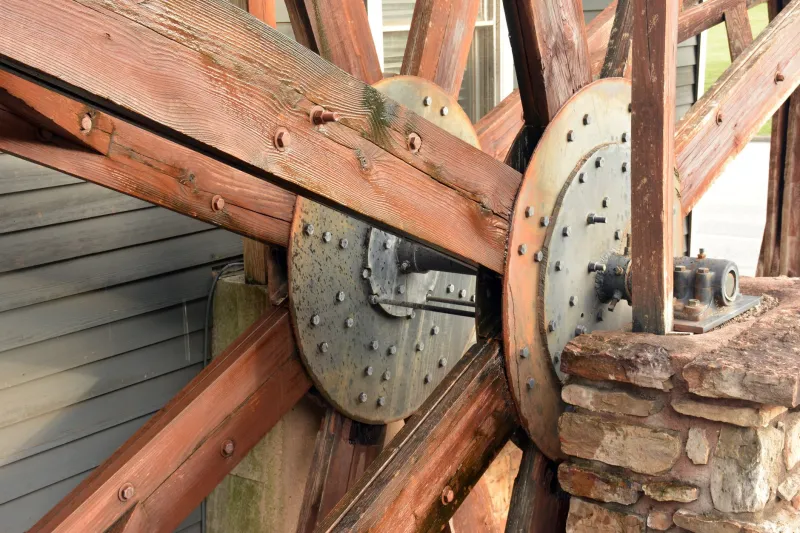
Water wheels and their associated infrastructure — the dams, headraces, flumes, and tailraces that deliver and return the water — add further complexity. A deteriorated earthen dam must be assessed for structural integrity before a wheel can be turned; a leaking wooden flume may require the fabrication of custom-dimensioned timber that modern sawmills do not routinely produce.
The People Who Carry the Knowledge
Those who have taken up this work are a varied company. Some are retired engineers or craftsmen who encountered a derelict mill by chance and found themselves unable to walk away from it. Others came through local historical societies, inheriting a preservation project along with a board membership. A number were drawn in by a specific mill that held personal or family significance — a structure their ancestors had once operated, or one that stood at the center of a community they were determined to honor.
What they share, almost universally, is a willingness to learn through doing — and through seeking out the few remaining individuals who have done it before. The Millwright's craft has no accredited curriculum, no licensing body, no professional guild in the contemporary sense. Knowledge passes person to person, often across considerable distances, at workshops organized by preservation organizations such as the Society for the Preservation of Old Mills, which has served as a national clearinghouse for this community for more than five decades.
At working restoration sites — among them Yates Mill in Wake County, North Carolina, Mabry Mill along the Blue Ridge Parkway in Virginia, and the Mingus Mill in the Great Smoky Mountains — volunteers work alongside staff and consultants to maintain machinery that has been in continuous or near-continuous operation for well over a century. The flour and cornmeal these mills produce is often sold on-site or at local markets, providing both a modest revenue stream and a living demonstration of the mill's original purpose.
More Than Preservation
The significance of these efforts extends beyond the mechanical. When a gristmill is restored to working order and the community is invited to witness the grinding — to see raw grain transformed into meal by the turning of a stone that has been doing precisely that work for two hundred years — something shifts in the relationship between the present and the past. The mill ceases to be an artifact and becomes, once again, an actor.
For many rural communities, particularly those whose economic foundations have eroded over the same decades that saw their mills fall silent, the restoration of a working mill carries a particular resonance. It is a visible, tangible assertion that the knowledge and labor of earlier generations retain their value — that the past is not merely a curiosity to be displayed behind glass, but a living inheritance with something still to offer.
The volunteers who turn the sluice gates and dress the stones understand this implicitly. They are not, in their own estimation, simply repairing old buildings. They are maintaining a conversation — between communities and their landscapes, between the present generation and every generation that has stood in the same flour-dusted air, listening to the same deep, rhythmic turning of stone against stone, and understood themselves to be part of something larger and longer than a single life.
The water, as it always has, does the rest.