Thread by Thread: How America's Embroiderers Are Archiving the Stories History Left Behind
Thread by Thread: How America's Embroiderers Are Archiving the Stories History Left Behind
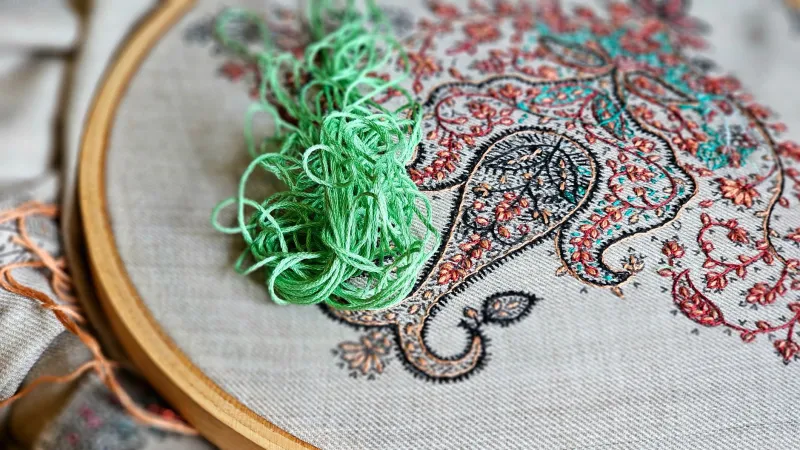
There is a particular kind of knowledge that never makes it into the county historical society's filing cabinets. It lives instead in the recollections of the very old, in the faded photographs tucked behind dresser mirrors, in the names carved into the backs of church pews. It is the knowledge of how a place actually felt — the sound of a mill whistle at dawn, the face of the woman who ran the feed store for forty years without ever being written about in the local paper. For a quietly determined community of needleworkers scattered across the United States, the most faithful instrument for capturing that knowledge is not a camera or a recorder. It is a threaded needle drawn through linen.
Across the country, embroidery guilds, needlework collectives, and solitary artisans working at kitchen tables are producing textile records of extraordinary ambition and intimacy. Their work ranges from panoramic town portraits stitched across panels the size of dining room tables to small, jewel-like samplers commemorating a single forgotten figure. What unites them is a conviction — rarely stated aloud but unmistakable in the work itself — that thread can hold what paper cannot.
The Living Timeline of a Mill Town
In the Connecticut River Valley of western Massachusetts, the Holyoke Needlework Collective has spent the better part of seven years constructing what its members call simply "the Panel." Spanning nearly fourteen feet when laid end to end, this embroidered chronicle traces the full arc of a mill town's existence: the clearing of the original forests, the engineering of the power canals in the 1840s, the arrival of successive waves of Irish, French-Canadian, and Polish workers, the slow contraction of the textile industry through the twentieth century, and the cautious, complicated renewal now underway.
Each section of the Panel was researched and designed by different guild members, then stitched collaboratively during weekly sessions that have themselves become a form of community ritual. The collective consulted newspaper archives, immigration records, and — crucially — the oral histories of residents whose grandparents worked the looms. Details that would never appear in an official account have been rendered in silk and wool: the particular red of a foreman's suspenders, the layout of a tenement kitchen, the way the canal water looked in winter under a particular angle of light.
"We are not illustrating history," says one of the collective's founding members, a retired schoolteacher who has been embroidering since her twenties. "We are arguing for a version of it. We are saying: these people mattered, and this is what their lives looked like."
Portraits in Thread: Honoring the Unrecorded
Some two thousand miles to the southwest, in the limestone hill country of central Texas, a different kind of embroidery project is underway. The Fredericksburg Heritage Stitch Circle — a group whose membership includes women ranging from their mid-thirties to their late eighties — has devoted itself to portraiture. Specifically, to the portraiture of individuals the community has collectively agreed deserve to be remembered but who have never received any formal recognition.
The subjects selected thus far include a Mexican-American midwife who delivered hundreds of babies in the region between the 1920s and the 1950s, a Czech immigrant farmer who taught himself English by reading legal documents and later helped neighbors navigate homestead claims, and a Black schoolteacher who ran an informal library out of her home during the years when the county's public facilities were segregated. None of these individuals appear in the town's official histories. All of them are now rendered in extraordinary detail — their expressions, their clothing, the objects that defined their work — in embroidered portraits that hang in the town's community center.
The circle's approach to research is rigorous. Members conduct interviews, examine photographs when they exist, and consult family members to ensure accuracy in both likeness and context. The goal, as several members describe it, is not sentimentality but something closer to correction — a gentle, beautiful insistence that the record be made whole.
Why Thread Endures
It is worth pausing to ask why embroidery, of all mediums, has emerged as such a persistent vehicle for community memory. Part of the answer is practical: textile work requires no specialized equipment, no institutional support, no grant funding (though some collectives have received modest assistance from state arts councils). It can be taken up and set down, carried to a meeting or a hospital waiting room, continued across years and across generations.
But the deeper answer may lie in the nature of the medium itself. Embroidery is slow. It demands sustained attention of a kind that digital documentation does not. To stitch a face is to study it in a way that mere photography never requires. To render a building in satin stitch is to understand its proportions from the inside out. There is an intimacy built into the process — a form of knowledge that accumulates, stitch by stitch, in the hands of the maker.
Historians and archivists who have begun to take notice of these projects speak carefully but with evident enthusiasm about their documentary value. Textile scholars note that embroidered records have an impressive track record of survival: the Bayeux Tapestry, after all, has outlasted virtually every other artifact of its era. Properly stored, a well-made piece of needlework can remain legible for centuries.
The Question of Continuity
And yet the projects themselves are not without vulnerability. The women — and they are, with rare exceptions, women — who anchor these collectives are often in the later decades of their lives. The Holyoke collective has struggled to attract members under fifty. The Fredericksburg circle has had more success, in part because several of its younger members came to the project through an interest in fiber arts broadly rather than through any prior attachment to traditional embroidery.
The question of what happens to these textile archives when their makers are gone is one that the artisans themselves discuss with a frankness that is both sobering and admirable. Some pieces have been formally donated to local historical societies or libraries. Others remain in private hands, their future uncertain. A handful of groups are working with regional museums to develop proper storage and display protocols.
There is also the question of documentation: whether the knowledge embedded in these textiles — the research, the choices, the stories behind each design decision — can be captured in some accompanying form before it is lost. Several collectives have begun recording video interviews with their members, creating a kind of meta-archive that preserves not only the finished work but the process and intention behind it.
A Different Kind of Record
What these embroiderers are doing sits at an unusual intersection of art, activism, and archival practice. Their work is beautiful, frequently stunning in its technical accomplishment. But beauty is not the primary point. The primary point is fidelity — to the places they inhabit, to the people those places have produced, to the texture of a shared life that is always, in every community, more complex and more worthy of attention than the official record suggests.
In an era when local newspapers have contracted dramatically and community institutions of all kinds face sustained pressure, these quiet practitioners of an ancient craft are doing something genuinely consequential. They are insisting, with needle and thread and remarkable patience, that the full story of a place deserves to be told — and that cloth, of all things, may be among the most honest places to tell it.