Hull and Soul: The Painted Fishing Boats That Carry America's Coastal Memory
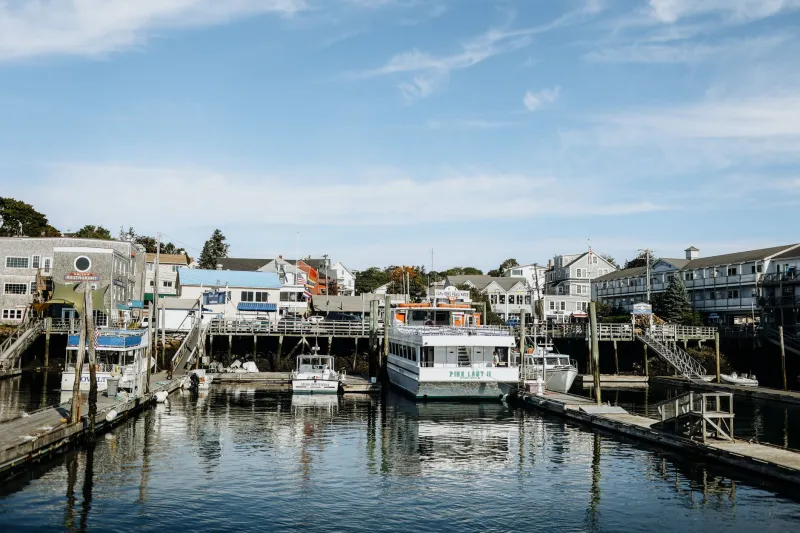
The Harbor as Gallery
Stand long enough at the edge of a working pier in Gloucester, Massachusetts, or Biloxi, Mississippi, or Astoria, Oregon, and the boats will begin to speak to you. Not in any metaphorical sense — though that, too — but in the precise visual language of color, lettering, and symbol that generations of fishing families have used to mark their vessels as unmistakably their own. A deep Prussian blue hull trimmed in gold leaf. A name rendered in shadowed block letters, the style passed down from a grandfather who learned it from a sign painter in Palermo before he ever saw the Atlantic. A small painted eye near the bow, an ancient Mediterranean ward against misfortune, transplanted to the coast of Rhode Island and maintained there for eighty years without anyone stopping to question its origin.
These are not incidental decorations. They are, in the truest sense, self-portraits — not of individuals, but of communities. And they are disappearing.
A Tradition With Deep Roots
The practice of decorating working watercraft predates the United States itself. European fishing cultures carried their visual traditions across the Atlantic with the same care they gave their nets and their recipes. Portuguese fishermen who settled along the New England coast brought with them a preference for vivid, saturated hull colors — deep reds, cobalt blues, bright whites — that made their vessels recognizable from a distance and, according to folk belief, pleasing to the sea. Sicilian immigrants working the oyster beds of Louisiana introduced painted eyes and floral motifs that echoed the elaborately decorated fishing boats of the Mediterranean. Scandinavian families in the Pacific Northwest favored clean, geometric trim work that reflected their own aesthetic inheritance.
Each of these traditions evolved in its new American setting, absorbing local influences and adapting to available materials, until what emerged was something genuinely regional — a Gulf Coast aesthetic that looked nothing like a New England one, which in turn bore little resemblance to what rode the swells off Puget Sound. The boats became, quite literally, floating archives of the immigrant experience, each coat of paint a layer of cultural translation.
The Men and Women Who Held the Brush
Behind every well-painted vessel was a craftsperson — sometimes the boat's owner, more often a specialist. The boatyard painter occupied a particular and respected niche in coastal communities, someone who understood not only the technical demands of marine-grade paint and its application to wooden hulls, but also the visual expectations of a discerning clientele with strong opinions about how their livelihood ought to look.
In many harbors, a single family might hold this role for generations. In Stonington, Connecticut, the Medeiros family painted boats for nearly sixty years, their lettering style so distinctive that longtime residents could identify their work at a glance. In the bayou communities south of New Orleans, itinerant painters moved between docks with a practiced ease, carrying their own formulas for mixing colors that would hold against the punishing humidity of the Gulf. In the fishing towns of Washington State, retired boatbuilders sometimes took up the brush as a kind of second vocation, preserving skills that had nowhere else to go.
Many of these practitioners are now in their seventies and eighties. Few have apprentices.
Fiberglass and the Fading of Form
The transition from wooden hulls to fiberglass, which accelerated through the latter decades of the twentieth century, changed not only the material reality of fishing boats but their aesthetic possibilities. Wood invited paint. Its surface was porous, forgiving, and deeply familiar to anyone trained in traditional decorative techniques. Fiberglass, by contrast, is smooth, unforgiving, and most naturally suited to the application of gel coat in a limited palette of manufacturer-specified colors. The economics of modern commercial fishing — tighter margins, longer seasons, smaller crews — leave little room for the kind of time-intensive hand painting that once distinguished one vessel from another.
The result, across many American harbors, has been a gradual homogenization. Boats that once announced their owners' identities from across the water now sit in rows of indistinguishable white hulls, their names applied in vinyl lettering purchased from a marine supply catalog. The information is there, but the expression is gone.
Keepers of the Tradition
Not everywhere, and not entirely. In pockets along every coastline where the old fishing cultures remain intact, the painted boat endures — sometimes as conscious preservation, sometimes simply because certain families have never considered doing it any other way.
In Gloucester, a city whose relationship with the sea stretches back four centuries, a handful of families still commission hand-painted vessels in the Portuguese tradition, treating the work as both aesthetic choice and act of cultural continuity. In the small shrimping communities of coastal Georgia, boat names rendered in elaborate script remain a point of pride, the lettering styles themselves passed between neighbors like recipes. In Alaska, where Native fishing families operate vessels decorated with clan symbols and traditional Northwest Coast design elements, the painted boat carries an additional weight of cultural sovereignty — a statement of presence and persistence on waters their ancestors have worked for millennia.
Organizations dedicated to maritime heritage have begun to take notice. Several New England maritime museums have initiated documentation projects, photographing existing painted vessels and recording oral histories from the craftspeople who made them. A small number of younger painters, trained in fine arts programs and drawn to the intersection of folk tradition and visual culture, have begun seeking out older practitioners as mentors, learning not just technique but the contextual knowledge that gives the work its meaning.
What the Fading Tells Us
The decline of the painted fishing boat is not, at its core, a story about paint. It is a story about the conditions under which folk art traditions flourish and the conditions under which they do not. Those conditions — tight-knit communities, stable occupational cultures, enough economic breathing room to invest in beauty — have been under pressure in coastal America for decades. The consolidation of the fishing industry, the rising cost of waterfront property, the departure of young people from traditional livelihoods: these forces have remade the harbors, and the boats reflect that remaking.
What remains is worth attending to carefully. Each painted vessel still working American waters is a document — of a family's history, a community's aesthetic values, an immigrant culture's long negotiation with a new landscape. The eye near the bow that no one remembers the origin of anymore is still doing its ancient work, watching the horizon for whatever comes next.
To see these boats clearly, before they are gone, is an act of cultural attention that the moment demands. The harbors are still full of stories. We need only learn, again, how to read them.