Reading the Dead: How Gravestone Scholars Are Decoding America's Oldest Open-Air Archives
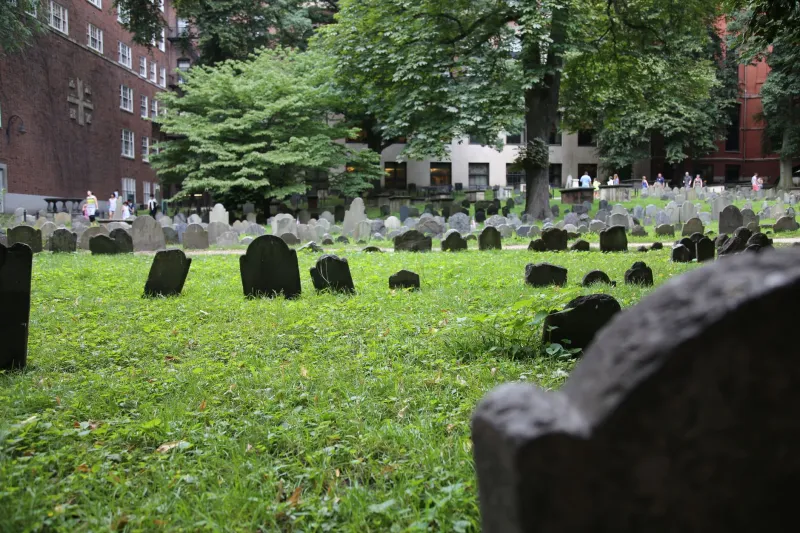
The stone leans at an angle that speaks of centuries, its surface mottled with lichen the color of old pewter. Carved into its face, still legible beneath the biological crust, is a winged skull — its hollow orbits fixed on no particular horizon — and beneath it, a name, a date, and four lines of verse warning the living that their own reckoning approaches. The grammar is archaic. The sentiment is urgent. The carver has been dead for two hundred and fifty years.
This is not a museum exhibit. It is a public document, exposed to every season, accessible to anyone willing to push open a wrought-iron gate. And it is disappearing.
The Archive Beneath the Grass
America's historic burial grounds represent one of the most democratic archives in the national record. Unlike courthouse documents or church registers — which recorded births, marriages, and deaths in the language of institutional authority — gravestones were commissioned by families, composed by the bereaved, and carved by local craftspeople whose aesthetic vocabularies evolved in direct response to the communities they served. They are, in the most literal sense, primary sources: physical objects that encode social history, religious belief, demographic data, and artistic tradition in a single carved surface.
The information density of a well-preserved colonial gravestone can be remarkable. A death date and age at death, cross-referenced against other stones in the same yard, can reveal the contours of epidemic disease — the clustering of dates in a single season, the disproportionate mortality among children, the sudden absence of an entire family line. Epitaphs, when they extend beyond the conventional, occasionally preserve fragments of personality, occupation, or circumstance that survived in no other form. The stones of enslaved individuals, where they exist at all, carry a particular historical weight: sometimes nameless, sometimes bearing only a first name, sometimes inscribed with a dignity that their subjects were denied in life.
The Carvers and Their Codes
For scholars of early American funerary art, the iconographic vocabulary of colonial gravestones constitutes a visual language as coherent and traceable as any written text. The winged skull — technically a death's head — dominated New England gravestone imagery throughout the seventeenth and early eighteenth centuries, its grim geometry reflecting a Calvinist theology that found little comfort in the softening of mortality's edges. Over the course of the eighteenth century, the death's head gradually yielded to the winged cherub, a shift that historians of religion read as evidence of a broader cultural movement toward a more optimistic Protestant eschatology. By the early nineteenth century, the willow-and-urn motif had largely supplanted both, its neoclassical restraint reflecting Enlightenment ideals of rational grief.
These stylistic transitions were not uniform across the colonies. Regional carving traditions developed distinctive vocabularies — the work of Boston-area carvers like the Lamson family is identifiable by specific facial conventions; stones from the Connecticut River Valley carry their own characteristic border treatments and lettering styles. Serious researchers can, in many cases, attribute unsigned stones to specific workshops or even individual hands, constructing a picture of itinerant craftspeople moving between communities, carrying their chisels and their aesthetic assumptions with them.
"The carvers were the graphic designers of their era," observes Dr. Patricia Hollenbeck, a funerary art historian affiliated with a Connecticut preservation society. "They had pattern books, they had local traditions, they had clients with specific requests. When you learn to read the stones, you start to see the individual personalities behind them — the carver who always gave his cherubs slightly asymmetrical wings, the one who preferred a particular serif on his capital letters. These were artists working within a tradition, and their choices tell us things."
Conservators in the Churchyard
Preservation of historic gravestones is a discipline that sits at the intersection of art conservation, archaeology, and community advocacy. The enemies are numerous: acid rain and atmospheric pollution, freeze-thaw cycles that exploit micro-fractures in stone, biological growth that gradually digests the carved surface, and well-intentioned but damaging interventions — most notoriously, the application of latex rubber for rubbings, a once-common practice now understood to cause significant harm to fragile surfaces.
The Association for Gravestone Studies, founded in 1977, has long served as the primary professional and educational network for this community, offering workshops in conservation technique, maintaining a research library, and publishing the peer-reviewed journal Markers. Its membership includes professional conservators, academics, genealogists, and an extensive cohort of dedicated amateurs whose fieldwork — systematic documentation of burial grounds, stone by stone — constitutes an irreplaceable contribution to the historical record.
Modern conservation practice favors the gentlest possible interventions. Biological growth is addressed with diluted biocidal solutions applied with soft brushes; broken or leaning stones are stabilized with conservation-grade adhesives and carefully placed supports rather than aggressive re-setting. The goal, as one Massachusetts conservator puts it, is to "stop the loss without adding to the confusion" — to arrest deterioration while preserving the authentic record of what time and use have already done to a stone.
Photogrammetry and three-dimensional scanning have introduced new possibilities for documentation, allowing researchers to capture surface detail that the naked eye might miss and to create permanent digital records of stones whose physical survival cannot be guaranteed. Several state-level projects are now working to compile searchable digital databases of historic burial grounds, making the information encoded in thousands of individual stones available to researchers and genealogists who may never set foot in the churchyard.
The Stories That Almost Disappeared
Among the most consequential work being done in this field is the systematic documentation of African American burial grounds — many of them long abandoned, overgrown, or built over — and the recovery of the histories they contain. Across the South and in Northern cities alike, researchers and community members have identified burial sites that were effectively lost to living memory, their stones sunk below grade, their boundaries unmarked, their existence unacknowledged in official records.
The recovery of these sites is not merely an act of historical scholarship. It is, for the communities involved, a form of recognition — an insistence that the individuals interred there were, and remain, worthy of remembrance. The carved names and dates, where they survive, are evidence against erasure. Where stones have been lost entirely, oral history and archival research labor to reconstruct what the physical record can no longer supply.
"Every stone we document is a voice we keep from going silent," says James Beaumont, a volunteer with a Virginia-based burial ground preservation project. "Some of these people left no other trace. No deed, no will, no letter. Just this stone. And if we don't record it now, it's gone."
The Ongoing Conversation
America's historic burial grounds are not static museums. They are active sites of memory, contested and maintained by communities whose relationships to the dead interred within them are various and ongoing. Preservation work, at its best, is conducted in genuine partnership with those communities — not imposed upon them by outside experts, however well-intentioned.
What the conservators and scholars and devoted amateurs share, across all their differences of method and focus, is a conviction that the ordinary dead deserve the same careful attention we extend to the famous and the powerful. The weathering stone, the fading epitaph, the winged skull staring into an indifferent sky: these are not relics of a finished past. They are the beginning of a conversation that the living have not yet finished having.