Spanning Time: The Engineers and Advocates Who Refuse to Surrender America's Historic Bridges
A bridge is, at its most elemental, a problem solved. Water, ravine, or valley presents itself as an obstacle, and human ingenuity responds with timber, stone, iron, or steel arranged according to principles that, in their most sophisticated expressions, rise to the level of art. The result is a structure that is simultaneously functional and declarative—a statement about what a community values, what it aspires to, and how it understands its relationship to the landscape it inhabits.
This is why the loss of a historic bridge is never merely an engineering matter. When a covered wooden span in Vermont is condemned and demolished, or when a nineteenth-century iron truss over a Kentucky river is replaced by a standard-issue concrete deck, something more than a crossing is removed from the world. A record is destroyed. A particular solution to a particular problem—one that reflects the materials, the skills, the economics, and the aesthetic sensibilities of a specific moment in American history—is rendered permanently inaccessible to the future.
The men and women who have dedicated themselves to preventing such losses constitute one of the more unusual communities in American preservation. They are, by turns, structural engineers and architectural historians, county commissioners and retired carpenters, grant writers and amateur photographers. What unites them is a conviction that historic bridges deserve the same institutional seriousness that is routinely accorded to historic buildings—and a frustration that this conviction is not yet universally shared.
The Covered Bridge and Its Discontents
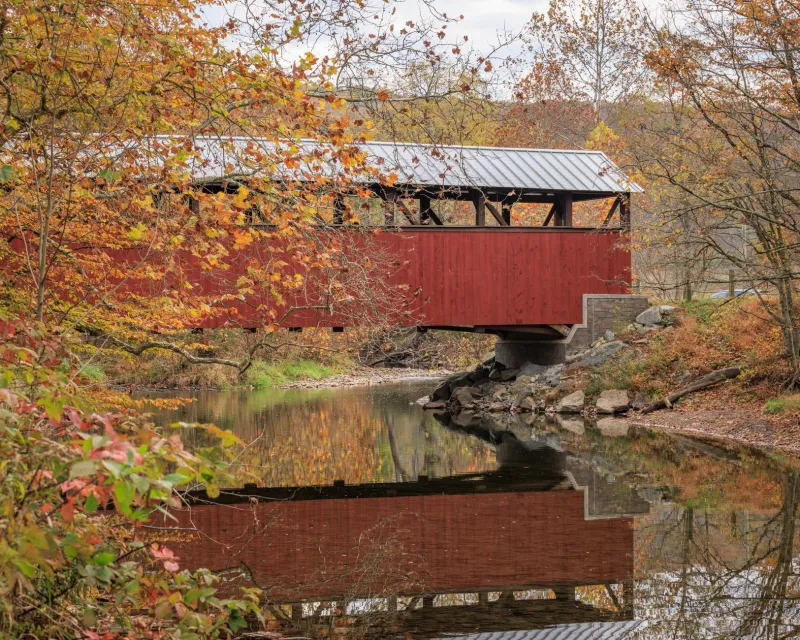
No category of historic bridge has attracted more devoted advocacy than the covered wooden span, and none has suffered more dramatic losses. At the peak of their construction in the mid-nineteenth century, an estimated ten thousand covered bridges stood across the United States. Today, approximately seven hundred remain—a figure that represents both a remarkable survival rate, given the structural vulnerability of wooden construction, and a sobering testament to the pace of demolition over the past century.
The covered bridge endures in the American imagination as a symbol of rural tranquility, and this cultural resonance has proven both an asset and a liability for preservation efforts. On one hand, it generates public affection that translates, in some communities, into political will and private donations. On the other hand, it can reduce these sophisticated engineering achievements to sentimental icons, obscuring the technical ingenuity they represent.
The lattice truss design patented by Ithiel Town in 1820, for instance, was a genuine engineering innovation—a method of distributing load across a web of diagonal timbers that allowed bridges of unprecedented span to be constructed by relatively unskilled labor using standardized components. The Burr arch truss, the Howe truss, the Queenpost and Kingpost configurations that appear in covered bridges from Maine to Oregon each represent a distinct engineering lineage, a specific response to the structural challenges of spanning water with wood. To appreciate these structures only as picturesque is to misread them fundamentally.
"People stop to photograph covered bridges because they're beautiful," says Dr. Ellen Marsh, a structural engineer who has assessed more than two hundred historic bridges for state and county preservation programs. "But the reason they're beautiful is the same reason they work: the form follows the function with extraordinary precision. When you understand the engineering, the aesthetics make complete sense. They're not decorative—they're expressive."
Iron, Steel, and the Industrial Sublime
Beyond the covered bridge lies a less romantically freighted but equally significant category of historic span: the iron and steel truss bridges of the late nineteenth and early twentieth centuries. Produced in enormous numbers by foundries and fabricating firms across the industrial Midwest, these structures brought modern bridge technology to rural counties that could not have afforded custom engineering, and in doing so connected communities to markets, to each other, and to the broader national economy.
Many of these bridges were produced by firms whose names—Wrought Iron Bridge Company, King Iron Bridge and Manufacturing, Groton Bridge and Manufacturing—are now known only to specialists. Their catalog designs, reproduced in county after county across the central and western United States, represent a kind of vernacular industrial architecture: standardized, economical, and yet, in their honest expression of structural logic, possessed of a genuine and austere beauty.
The preservation of iron and steel truss bridges presents challenges that differ substantially from those of wooden spans. The structures themselves are often more durable—properly maintained iron and steel can last indefinitely—but the political and economic pressures against their retention are frequently more intense. A county road department confronting a deteriorating truss bridge must weigh the cost of rehabilitation against the cost of replacement with a structure that will require less specialized maintenance and will accommodate heavier loads. In a fiscal environment of chronic constraint, the calculus rarely favors preservation without external advocacy and, often, external funding.
The Rehabilitation Argument
The case for rehabilitating rather than replacing historic bridges rests on several distinct foundations, and the preservation community has learned, through experience, that different arguments resonate with different audiences.
For engineers and transportation officials, the most compelling argument is often structural: many historic bridges, properly rehabilitated, are capable of serving contemporary traffic loads with modifications that are less disruptive than they might appear. The Historic Bridge Foundation and similar organizations have documented numerous cases in which predicted rehabilitation costs proved substantially lower than initial estimates, and in which rehabilitated historic bridges have performed reliably for decades after treatment.
For community advocates and elected officials, the economic argument has gained traction: studies in multiple states have demonstrated that historic bridges, particularly covered spans, function as tourism assets capable of generating measurable economic activity in rural communities. A covered bridge that attracts visitors to a county that might otherwise receive none is an economic resource as well as a cultural one.
For historians and the broader public, the argument is ultimately about identity. "These bridges are where your great-grandparents crossed," says James Alcott, who coordinates a statewide bridge preservation program in Indiana. "They're where the county fair wagon went. They're where the school bus crossed every morning for fifty years. When you take them out, you take out a piece of the community's physical memory. You can't put that back."
A Coalition of the Committed
The preservation of America's historic bridges has been advanced, incrementally and imperfectly, by a coalition whose diversity reflects the breadth of what is at stake. Federal programs administered through the Federal Highway Administration have provided funding for historic bridge preservation since the 1980s, though the amounts available have rarely matched the scale of the need. State historic preservation offices have documented and advocated for significant spans within their jurisdictions. And at the local level, organizations ranging from county historical societies to informal groups of concerned citizens have fought, bridge by bridge, to prevent demolitions that seemed, to those who authorized them, entirely routine.
The victories are real, if modest. A Pratt truss in rural Missouri, slated for demolition in 2019, was rehabilitated and reopened after a sustained community campaign and a federal preservation grant. A covered bridge in New Hampshire, condemned following a flood, was disassembled, its timbers cataloged and treated, and reconstructed on its original site by craftsmen who had learned the relevant joinery techniques specifically for the project. A swing bridge in coastal Louisiana, its ornamental ironwork corroded beyond casual recognition, was painstakingly restored by a team that included a marine engineer, an architectural historian, and a retired ironworker who had, as a young man, helped maintain the original structure.
Each of these recoveries is, in its way, a small miracle—a demonstration that the will to preserve, when sufficiently organized and sufficiently persistent, can prevail against the considerable institutional momentum toward replacement. The bridges that survive are not merely crossings. They are arguments, made in timber and iron and steel, for the proposition that the ingenuity of the past deserves a place in the present—and that some spans, once lost, cannot be rebuilt.