Phosphates, Patience, and the Marble Counter: America's Soda Fountains and the Communities They Sustain
Phosphates, Patience, and the Marble Counter: America's Soda Fountains and the Communities They Sustain
There is a particular quality of light inside an old American soda fountain — the kind that filters through hand-lettered window glass, catches on chrome fixtures, and settles across a marble counter worn smooth by a century of elbows and conversation. It is a light that seems to belong to a different chapter of the national story, one written in the cursive of handwritten menus and the gentle hiss of a carbonation tap. Across the United States, a small and steadfast number of these establishments still operate much as they did when Woodrow Wilson occupied the White House. The families who maintain them are not merely running businesses. They are, in the most literal sense, keeping memory alive.
The Fountain as Commons
To understand what the soda fountain once meant to American civic life, one must set aside the modern notion of a café as a transactional space. The drugstore soda fountain of the late nineteenth and early twentieth centuries occupied a different social register entirely. It was simultaneously a place of commerce, medicine, leisure, and community deliberation. Pharmacists, who in many small towns were among the most educated residents, compounded prescriptions behind a counter just steps from where they also crafted phosphate drinks, hand-dipped ice cream, and elaborate sundaes assembled with the precision of an apothecary.
The soda fountain democratized refreshment. For the price of a nickel — and later a dime — a factory worker, a schoolteacher, and a merchant's wife might occupy adjacent stools without ceremony or distinction. The counter itself functioned as an equalizer, a long marble surface that invited strangers into proximity and proximity into conversation. Town gossip traveled across those counters. Courtships began there. Grievances were aired and occasionally resolved. In the era before the automobile reshaped American geography and the chain restaurant homogenized its flavors, the soda fountain was the commons that civic philosophers had long theorized but rarely located so precisely.
Survivors on Main Street
The establishments that have endured into the present century are remarkable not only for their longevity but for the deliberateness of their survival. In Brenham, Texas, the Blue Bell Creameries heritage draws visitors who seek out old-fashioned parlors still serving hand-dipped portions. In Odessa, New York, the Sunrise Family Restaurant preserves a working fountain counter that predates the Second World War. Across small-town Pennsylvania, Ohio, and the upper Midwest, a traveler patient enough to slow down and look will still find the telltale signs: the rotating stool, the mirrored back bar lined with glass syrup bottles, the hand-chalked daily specials.
Many of these places are operated by second- or third-generation families who absorbed the rhythms of fountain work in childhood and never quite managed — or wished — to escape them. They speak of their counters with a reverence that is neither performative nor nostalgic in the sentimental sense. It is, rather, the reverence of stewardship: an acknowledgment that what they tend belongs not entirely to them but to the community that has gathered around it for generations.
Margaret Hollenbeck, whose family has operated a pharmacy and fountain counter in rural Indiana since 1931, describes the weight of that responsibility with characteristic plainness. "People come in here and they see their grandmother's stool," she has said. "That's not something you just close up and walk away from."
The Preservation Imperative
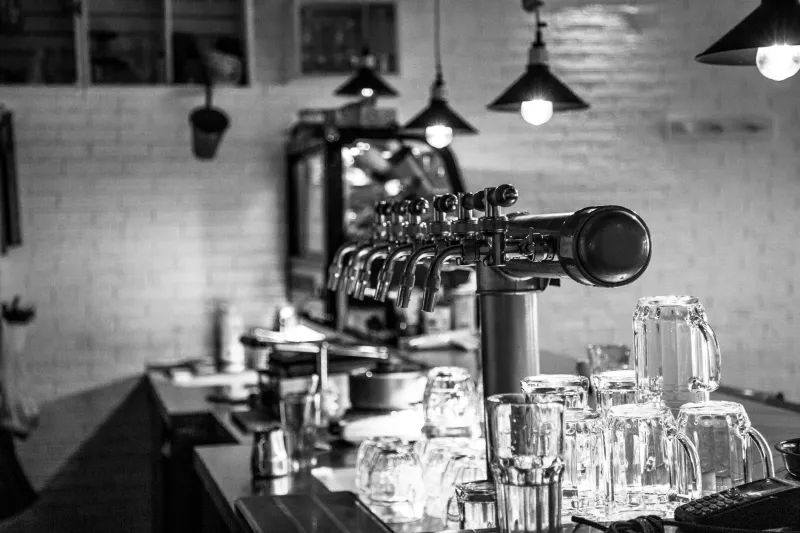
For those working outside the family tradition, the effort to protect surviving soda fountains has taken on the character of a preservation campaign — urgent, sometimes underfunded, and driven by volunteers whose passion outpaces their resources. Organizations devoted to the conservation of Main Street commercial architecture have increasingly recognized the soda fountain interior as a distinct and endangered category of American material culture. The marble counters, the ornate back bars with their etched glass panels, the porcelain syrup dispensers, the nickel-plated tap assemblies — these are artifacts as worthy of scholarly attention as any object in a museum vitrine, and considerably more fragile in their original context.
The challenge is that soda fountain equipment, unlike a painting or a ceramic, exists within a living commercial environment subject to health codes, insurance requirements, and the relentless arithmetic of operating costs. A marble counter can survive a century of daily use but cannot survive a landlord's rent increase or a family's inability to find a successor willing to learn the trade. Landmarking a commercial interior offers some protection, but the process is slow, the criteria are uneven across jurisdictions, and the political will is not always present.
Grassroots advocates have responded with a combination of documentation and direct action. Oral history projects have captured the recollections of working soda jerks — a term that derives from the jerking motion used to operate early carbonation equipment — before those voices are lost. Architectural photographers have recorded interiors in exhaustive detail. In several communities, local historical societies have partnered with pharmacy schools and culinary programs to revive the technical knowledge required to operate vintage equipment, ensuring that the craft itself does not expire with its current practitioners.
What the Marble Remembers
There is a tendency, when discussing places like these, to reach for the language of loss — to frame the soda fountain as a casualty of modernity, a charming anachronism outpaced by a culture that has chosen convenience over character. That framing is not entirely wrong, but it is incomplete. The fountains that survive do not persist as monuments to a vanished era. They persist because they continue to fulfill the function they were built for: bringing people together around a shared surface, a shared pleasure, and the unspoken agreement that the next few minutes belong to no particular urgency.
The phosphate may have given way to the artisan lemonade, and the egg cream may be a curiosity rather than a staple, but the marble counter remains. It has absorbed the conversations of the newly married and the recently bereaved, the arguments of neighbors who disagreed and returned the following Tuesday regardless, the laughter of children encountering a banana split for the first time. That accumulation is not merely sentimental. It is historical. It is, in the most precise sense, what heritage means when it is still warm to the touch.
To sit at one of these remaining counters is to participate in an unbroken chain of American communal life that stretches back well over a century. The stool may wobble slightly. The menu may be handwritten on a board that has not changed in decades. The person behind the counter may be the grandchild of the person who built it. None of that is incidental. All of it is the point.
The last soda fountains are not relics. They are, for the communities fortunate enough to still possess them, among the most living things on Main Street.