Counter Culture: The Dime Store Diners That Outlasted an Era and Became Keepers of American Memory
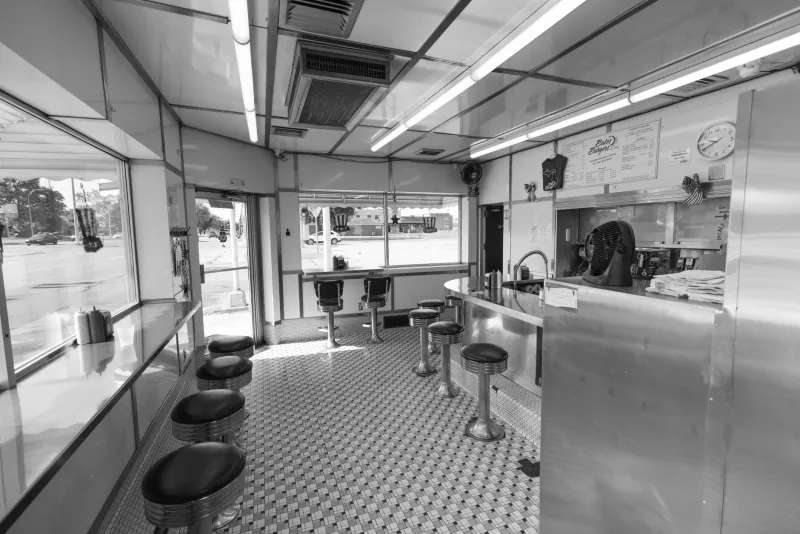
There is a particular quality of light inside a surviving lunch counter — a warm, slightly amber glow that seems to belong to no specific decade and yet to all of them at once. The chrome trim catches it. The laminate countertop reflects it. The rotating pie case, if one is fortunate enough to find it still turning, refracts it into something almost ceremonial. These are not grand spaces by any conventional measure, yet they possess a gravity that far exceeds their modest square footage.
Across America, a diminishing number of these counters — relics of the Woolworth's era and the golden age of the five-and-dime — have survived into the present century. They exist in small Ohio river towns, in the courthouse squares of rural Georgia, in the faded commercial corridors of New England mill cities. Each one is, in its way, an accidental monument: a place that endured not through deliberate preservation but through stubbornness, community loyalty, and the quiet insistence of families who could not quite bring themselves to close the door for the last time.
The Architecture of the Ordinary
To understand what makes these spaces so resonant, one must first appreciate their original design philosophy — which was, paradoxically, to have no philosophy at all. The lunch counters appended to five-and-dime stores were conceived as purely functional additions. A row of stools bolted to the floor. A counter wide enough for a plate and a coffee cup. A pass-through window to the kitchen. The intention was efficiency, not atmosphere.
And yet, in their very unpretentiousness, these spaces became something rare in American commercial life: genuinely democratic rooms. A factory worker and a bank manager occupied stools of identical height, eating from plates of identical weight, waited upon with identical attention. The lunch counter leveled, at least temporarily, the social hierarchies that governed nearly every other public space in mid-century America.
This is precisely why their physical details matter so profoundly to preservationists. The original tile floors, the stainless steel soda dispensers, the hand-lettered menu boards — these are not merely decorative holdovers. They are the material evidence of a particular social arrangement, one that deserves to be read as carefully as any architectural document.
"When people walk in and see that everything is still here — the same stools their grandparents sat on, the same counter — you can watch something happen to them," says the third-generation owner of a lunch counter in a small Indiana town that has operated continuously since 1947. "They don't just remember the food. They remember who they were."
The Civil Rights Inheritance
No honest account of the American lunch counter can avoid its most consequential chapter. In February 1960, four Black college students sat down at a Woolworth's lunch counter in Greensboro, North Carolina, and quietly requested service. They were refused. They remained seated. Within weeks, sit-in demonstrations had spread to dozens of cities across the South, and the lunch counter had been transformed from a symbol of ordinary American life into a front line of the struggle for human dignity.
The complexity of this history is not lost on those who now operate and preserve these spaces. For many communities — particularly in the South — the surviving lunch counter is simultaneously a site of nostalgia and a site of reckoning. The same swivel stool that one family remembers as the place their father proposed marriage may, in another family's memory, represent exclusion, humiliation, and the daily violence of segregation.
Several preservation efforts have made the deliberate choice to hold both narratives simultaneously. In one Mississippi town, a restored lunch counter now displays oral history recordings alongside its original menu boards — the voices of elderly Black residents describing what it meant to finally be served at that counter alongside the voices of white regulars recalling the same space with uncomplicated warmth. The juxtaposition is intentional and, at times, uncomfortable. It is also, preservationists argue, essential.
"We can't just restore the chrome and call it heritage," says one community historian involved in such a project. "The full story of these places is the only story worth telling."
The Families Who Stayed
The survival of any particular lunch counter is almost always attributable, in the end, to a single family's refusal to surrender. These are not, as a rule, families of great means. They are families of great attachment — to a place, to a practice, to the particular rhythm of opening the door at seven in the morning and closing it at three in the afternoon.
The economics of the surviving lunch counter are, by any rational measure, precarious. Food costs have climbed steadily while the customer base has aged and, in many small towns, diminished. The equipment that gives these spaces their character — the vintage soda fountains, the commercial pie cases, the original griddles — requires specialized maintenance that grows harder to source with each passing year. Parts are fabricated by hand. Repairmen who remember the original machinery are themselves approaching the age of retirement.
And yet these families persist. Some have introduced modest modernizations — a point-of-sale tablet here, a social media presence there — while preserving the essential character of the space. Others have remained almost militantly unchanged, accepting lower margins as the price of authenticity. A few have found unexpected lifelines in heritage tourism, as travelers seek out the genuinely old in a landscape increasingly dominated by the deliberately vintage.
"People drive two hours for a bowl of vegetable soup and a piece of pie," says one owner, with a mixture of bemusement and gratitude. "Not because the soup is the best soup in the world. Because it's the real thing. Because nothing here is pretending to be something it isn't."
What Endures
There is a term used occasionally in architectural preservation circles — "living heritage" — that describes structures and spaces that maintain their significance not through museum-like stasis but through continued use. The lunch counter, at its best, exemplifies this quality. It is not preserved behind glass. It is preserved by the act of sitting down, ordering coffee, and remaining for a while.
This is, perhaps, the most democratic form of cultural stewardship available to ordinary Americans. One need not donate to an endowment or attend a gala to participate in the preservation of a lunch counter. One need only show up, occupy a stool, and contribute to the unbroken chain of daily life that gives the place its meaning.
As the number of these counters continues to contract — victims of retirement, rising costs, and the indifference of a market that rarely rewards the genuinely old — the urgency of that participation becomes more apparent. The loss of each one is not merely the loss of a restaurant. It is the loss of a particular kind of social space, a particular texture of community life, and an irreplaceable repository of layered, complicated, deeply human memory.
The light inside these places, that warm amber glow, will not last forever. But for now, in a handful of towns across this country, it continues to fall across the chrome and the laminate and the faces of people who have been coming here, in some cases, for the whole of their lives. That, in itself, is a form of grace worth honoring.