Before the Big Top Arrived: The Lost Art of the American Circus Lithograph
There was a particular kind of electricity that swept through a small American town when the circus posters appeared. Overnight, as though conjured by some showman's spell, the weathered planks of a livery stable or the broad side of a general store would bloom with color — lions mid-roar, aerialists suspended in impossible arcs, elephants draped in jeweled regalia. The circus had not yet arrived, but its promise had. And that promise was delivered entirely through ink, stone, and the meticulous labor of craftsmen whose names rarely appeared anywhere on the bills they produced.
Those posters — bold, oversized, and deliberately overwhelming — represent one of the most distinctive vernacular art forms in American commercial history. They were not merely advertisements. They were events unto themselves, and the communities that gathered to study them were, in a very real sense, already participating in the spectacle before a single tent stake had been driven into the ground.
The Lithographer's Craft and the Language of Wonder
At the height of the American circus era, roughly spanning the 1870s through the mid-twentieth century, the production of circus lithographs was a sophisticated industrial enterprise. Printing houses such as the Strobridge Lithographing Company in Cincinnati and the Erie Litho & Printing Company in Pennsylvania employed teams of artists, stone grinders, and press operators working in carefully coordinated succession. A single poster might require a dozen or more separate stone impressions to achieve its characteristic density of color and detail.
The artists who designed these images operated within a highly specialized visual grammar. Figures had to read clearly at great distance. Colors needed to retain their vibrancy after being pasted to rough outdoor surfaces and exposed to rain, wind, and sun. Lettering — hand-drawn rather than set in type — had to be simultaneously legible and theatrical, communicating urgency and grandeur in equal measure. It was, in every sense, a discipline that demanded both technical precision and an almost intuitive understanding of how the human eye seeks drama.
The resulting imagery was unlike anything else being produced in American print culture at the time. Where newspaper illustrations were modest and restrained, circus posters were unapologetically operatic. They depicted a world of heightened possibility, one in which ordinary physical laws bent willingly to the demands of spectacle.
Baraboo and the Archive of Amazement
The most significant repository of American circus lithographs in existence today is housed not in a major metropolitan museum but in Baraboo, Wisconsin — a small city that served for decades as the winter home of the Ringling Brothers Circus. The Circus World Museum, established in 1959 on the original Ringling quarters, holds a collection of more than eight thousand circus posters spanning well over a century of American showmanship. It is, by any reasonable measure, an archive of astonishment.
Curators at the museum have spent years not only preserving existing examples but also documenting the provenance and production history of individual posters — tracing particular images back to specific printing houses, identifying the artistic hands behind unsigned works, and reconstructing the distribution networks that carried these bills to towns across the country. The work is painstaking and, for those engaged in it, clearly a matter of genuine passion.
What the collection reveals, beyond its obvious visual splendor, is the extraordinary geographic reach of the circus poster system. Advance men — employees dispatched weeks ahead of the traveling show — would negotiate with local merchants for wall space, then direct teams of bill posters who applied the lithographs in overlapping layers using flour-based paste. A single town might receive hundreds of individual sheets, tiled together to form compositions of truly monumental scale. The countryside, in those weeks before the circus arrived, became a kind of open-air gallery.
Revival and the Return of the Stone
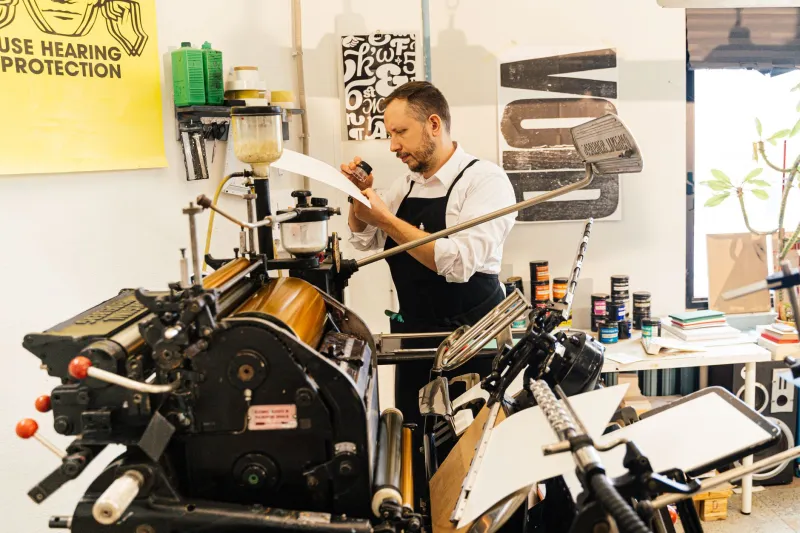
In recent years, a modest but determined revival of circus-style lithography has taken root among American letterpress and fine art printers. Shops in cities including Chicago, Portland, and Nashville have begun producing limited-edition circus posters using restored vintage presses and, in some cases, actual lithographic stones sourced from defunct printing houses. The motivations vary — some practitioners are drawn primarily to the technical challenge, others to the graphic tradition itself — but the results share a common quality of deliberate, labor-intensive beauty that digital production methods simply cannot replicate.
These contemporary practitioners are careful to acknowledge the distinction between revival and reproduction. Their work draws on the visual language of the golden age without pretending to inhabit it. Figures are updated, typography occasionally modernized, and the subject matter sometimes expanded well beyond the circus tent. What remains constant is the commitment to a process in which every color, every line, and every letterform is the product of physical labor and considered craft.
Several of these shops have also begun partnering with cultural institutions to produce educational materials about the history of circus lithography, bringing the tradition to audiences who might otherwise encounter it only as a footnote in design history surveys. It is a quietly meaningful form of stewardship — one that honors the past without embalming it.
What the Posters Carried
To examine a well-preserved circus lithograph today is to encounter something that transcends its original commercial purpose. These images documented the aspirations of a culture that was, in the late nineteenth and early twentieth centuries, genuinely hungry for wonder. The circus offered Americans a reliable encounter with the exotic, the dangerous, and the improbable — and the posters that preceded it were the first chapter of that encounter.
They also captured, with remarkable fidelity, the graphic sensibility of their moment. The typography alone — those cascading hierarchies of wood and stone-cut letterforms, each size calibrated to a specific degree of importance — constitutes a complete visual history of American commercial lettering across nearly a century of stylistic evolution. Design historians have long recognized this, and the influence of circus poster aesthetics on subsequent American graphic traditions, from Depression-era government posters to mid-century advertising, has been extensively documented.
But perhaps the most resonant quality of the circus lithograph is its relationship to place. These were not generic images distributed indifferently across a national market. They were, in a meaningful sense, addressed to specific communities — pasted to the walls of specific towns, studied by specific people who would, in due course, gather together beneath the canvas of the big top and experience something genuinely communal. The poster was the first act of that gathering, and its disappearance from the American landscape marks a quiet but significant diminishment of a particular kind of shared anticipation.
Preserving the Promise
The individuals and institutions working to preserve the American circus poster are engaged in something more than archival housekeeping. They are maintaining access to a visual record of how this country once chose to announce joy — loudly, colorfully, and with a confidence in the power of spectacle to unite strangers into audiences, and audiences into communities.
In an era when so much of public visual culture has migrated to screens that flicker and vanish, there is something quietly radical about a printed image designed to be seen by an entire town, to weather the elements, and to outlast the event it was created to announce. The circus may have largely departed from the American countryside, but the posters, for those willing to seek them out, remain — vivid, insistent, and still faintly crackling with the electricity of arrival.