Hands in the Plaster: The Vanishing Masters Who Hold Our Historic Buildings Together
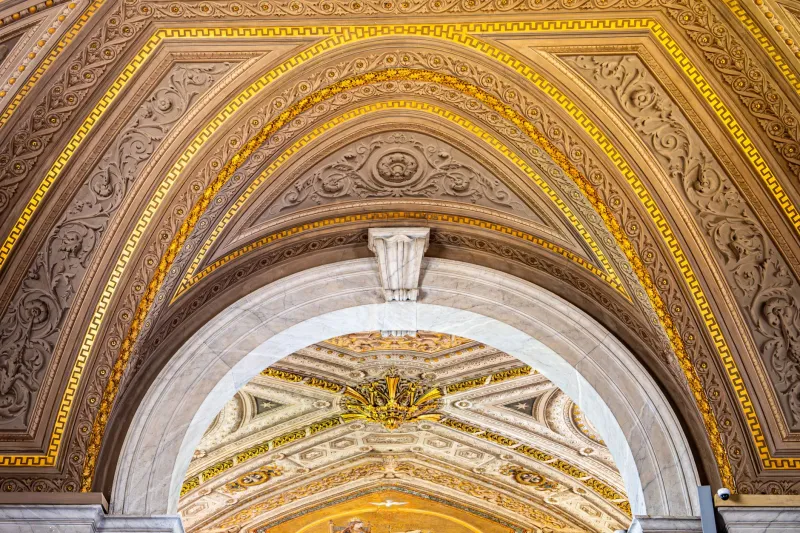
Run your hand along the cornice of a nineteenth-century courthouse and you are touching something made by a human being who has been dead for well over a century. The rosette pressed into the plaster ceiling of a Gilded Age opera house, the gilded acanthus leaf curling above a theater's proscenium arch, the leaded glass window casting its fractured color across a municipal staircase — each of these details was conceived and executed by a craftsperson whose name is almost certainly unrecorded, whose training was almost certainly transmitted orally and by demonstration, and whose work has outlasted not only its maker but entire chapters of American history.
That work now depends, for its survival, on another generation of craftspeople equally committed, equally skilled, and — by most accounts — considerably fewer in number. These are the master restorers: ornamental plasterers, architectural gilders, stained-glass conservators, and stone carvers who have dedicated their professional lives to the care of America's historic civic and cultural buildings. They are, in a very real sense, the custodians of an inheritance that most Americans have never been asked to consider, and the knowledge they carry is as irreplaceable as any artifact in a museum collection.
The Architecture of Civic Aspiration
To understand what is at stake in the preservation of these trades, it is worth pausing to consider what the buildings themselves represent. The great courthouses, state capitols, opera houses, and civic halls constructed in America between roughly 1840 and 1930 were not merely functional structures. They were deliberate expressions of civic ambition — monuments to the idea that democratic society deserved architecture of consequence, interiors of beauty, and public spaces that communicated dignity and permanence to all who entered them.
The craftspeople who built them worked within traditions that stretched back centuries, to the guilds of Renaissance Italy and the workshops of Georgian England. Ornamental plasterwork, for instance, requires a practitioner to understand not only the chemistry of lime and gypsum but also the geometry of classical ornament, the behavior of molds and casts, and the subtleties of surface finishing that determine whether a molding reads as crisp and authoritative or soft and indistinct. These are not skills acquired from a manual. They are transmitted, slowly and imperfectly, from one set of hands to another.
The Apprenticeship Imperative
It is this mode of transmission — intimate, embodied, resistant to digitization — that makes the current moment so precarious. Many of the master craftspeople active in historic restoration today learned their trades in the 1970s and 1980s, during a period of renewed interest in preservation spurred in part by the National Historic Preservation Act of 1966 and the subsequent growth of the preservation movement. They are now entering their sixties and seventies, and the pipeline of trained successors behind them is, by most accounts, inadequate to the demand.
Some transmission is occurring. Institutions such as the Preservation Trades Network, a national organization connecting craftspeople and educators, have worked to document endangered techniques and facilitate apprenticeship relationships. A handful of specialized programs — among them the North Bennet Street School in Boston and the Preservation Studies programs at several universities — offer formal instruction in traditional building crafts. Individual masters, too, have taken on apprentices, sometimes through formal arrangements and sometimes through the informal mentorship that has always characterized these trades.
But the economics of the situation are challenging. Historic restoration work is project-based and geographically dispersed, making it difficult to sustain the kind of steady, long-term apprenticeship that genuine mastery requires. Young craftspeople entering the field must often piece together their education from multiple sources — a season with one master, a course at a preservation school, hands-on work on a succession of projects — rather than receiving the sustained, integrated training that once defined the guild tradition.
Portraits in Craft
The people who persist in these trades tend to share certain qualities: a patience that borders on the monastic, an intellectual curiosity about historical technique, and an almost paradoxical combination of ego and humility — the confidence required to intervene in a masterwork of the past, tempered by profound respect for what one is touching.
An ornamental plasterer working on the restoration of a nineteenth-century state capitol must first analyze the existing plasterwork through close observation and, sometimes, laboratory testing — identifying the composition of the original mix, the tools used to apply it, the sequence of coats. She must then fabricate replacement moldings that match the original not merely in shape but in texture and density, using techniques that may require weeks of experimentation before a satisfactory result is achieved. The finished work, if done well, is invisible: indistinguishable from what surrounds it, which is precisely the point.
A stained-glass conservator working on a damaged window in a historic courthouse faces a different but equally demanding set of challenges. Original glass, produced by hand-blowing processes no longer in common use, has optical and chromatic qualities that modern manufactured glass cannot replicate. Sourcing replacement glass may require searching specialty suppliers, salvage collections, or even other damaged windows from the same period. The leading — the strips of came that hold the glass sections together — must be matched in profile and alloy to the original. The result, again, should be seamless: a repaired window that continues to tell its story without interruption.
What Is Lost When Knowledge Disappears
The consequences of losing these trades are not abstract. They are measurable in the condition of specific buildings across the country. When a historic plaster ceiling deteriorates beyond the capacity of available craftspeople to address it, the typical solution is replacement — with gypsum board, with fiberglass panels, with materials that may be functional but that cannot replicate the acoustic properties, the visual depth, or the historical authenticity of the original. When a stained-glass window is damaged and no conservator with appropriate skills is available, the glass may be patched with incompatible materials or removed entirely. In each case, something irreversible occurs.
Preservation architects and building historians speak of this phenomenon with a mixture of urgency and resignation. The buildings, they note, are not going anywhere — many are protected by landmark designation and federal tax incentives for historic rehabilitation. But protection of the structure does not guarantee preservation of its character, and character, in historic architecture, is largely a function of the craft details that give a building its texture, its warmth, and its connection to the human hands that made it.
A Love Letter in Lime and Gold
There is something quietly profound about the work of historic building restoration that resists easy articulation but that anyone who has witnessed it will recognize. It is the sight of a craftsperson kneeling before a damaged gilded surface, brush in hand, applying gold leaf with a patience that seems to belong to another century. It is the sound of a stone carver's mallet in a silent building, the rhythm of it steady and ancient. It is the smell of lime plaster setting in a room where the same smell once signaled the completion of a building that its makers believed would endure.
These craftspeople are not merely technicians. They are, in the fullest sense, practitioners of cultural memory — individuals who have chosen to locate their working lives at the intersection of past and present, accepting the responsibility of caring for what earlier generations made and passing that capacity of care forward to those who come after them.
At Silversides, we believe that the places where a community gathers — its courthouses, its opera houses, its civic halls — are among its most eloquent self-portraits. The people who tend those places, who keep their ceilings from falling and their windows from darkening, are doing work that deserves not only our gratitude but our attention. The clock they keep is one that measures not hours but generations, and its hands are human.