Ink, Iron, and Intention: The Artisan Printers Rescuing America's Letterpress Legacy
Ink, Iron, and Intention: The Artisan Printers Rescuing America's Letterpress Legacy
There is a sound that old-time printers still describe with something close to reverence — a measured, mechanical heartbeat, part thud and part whisper, as a platen press closes against a bed of inked type. For most of the twentieth century, that sound filled the back rooms of newspaper offices, wedding stationers, and political print shops from Boston to San Francisco. Then, almost without ceremony, it stopped.
The rise of offset lithography in the mid-twentieth century, followed by the digital revolution of the 1980s and 1990s, rendered the letterpress economically obsolete almost overnight. Presses that had operated continuously for decades were sold for scrap, dismantled, or simply abandoned in the back corners of warehouses. The knowledge that animated them — the careful packing of the platen, the precise mixing of oil-based inks, the intimate understanding of paper weight and impression depth — began to fade with the generation that had practiced it.
Yet something unexpected happened. The craft did not die. It went dormant, and then, quietly, it bloomed again.
A Craft Rooted in the American Story
To understand why letterpress endures, one must first appreciate how deeply it is woven into the fabric of American cultural memory. The earliest colonial print shops were not merely commercial enterprises — they were engines of democracy. Benjamin Franklin learned his trade at a Boston printing house before carrying those skills to Philadelphia, where the press became inseparable from the revolutionary pamphlets and broadsides that shaped the nation's founding arguments. The Declaration of Independence itself was first rendered in letterpress type, its words pressed deliberately into paper by John Dunlap in the early hours of July 5, 1776.
For the next two centuries, the letterpress was the primary instrument through which Americans communicated publicly and privately. Newspapers, legal documents, theatrical playbills, church programs, trade cards, and hand-addressed invitations all bore the characteristic impression of type or photoengraved cuts pressed into soft paper stock. That slight indentation — what printers call the "kiss" of the impression — gave letterpress its unmistakable tactile identity, a quality that no digital reproduction has ever fully replicated.
Rescued from the Scrapyard
When the revival began in earnest during the early 2000s, it was driven less by nostalgia than by a hunger for authenticity. A generation raised on screens found themselves drawn to objects that carried physical evidence of their own making — surfaces that bore the honest mark of process.
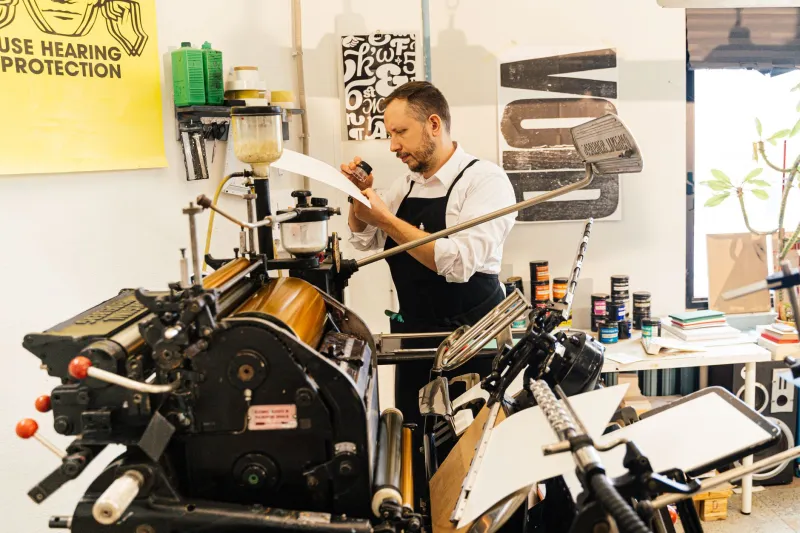
Across the country, collectors and curious craftspeople began tracking down vintage iron presses. The Heidelberg Windmill, a German-engineered marvel introduced to American commercial printing in the 1950s, became a particular object of devotion. Chandler & Price platen presses, manufactured in Cleveland, Ohio, from the late nineteenth century through the mid-twentieth, were pulled from barn floors and factory basements. Vandercook proof presses, originally designed for quality-checking type before a print run, found second lives as primary production tools in studios from Brooklyn to Portland.
Many of these machines required months of rehabilitation. Rollers had hardened and cracked. Ink fountains were corroded. Chases — the metal frames that hold composed type in place — had warped. The artisans who undertook these restorations often taught themselves through a combination of surviving manuals, online forums, and the generous mentorship of retired commercial printers who had never quite let go of the trade.
"There is no shortcut to understanding a press," says one studio owner in Chicago who restored a 1960s Heidelberg Windmill over the course of eighteen months. "You have to run it, listen to it, make mistakes on it. The machine teaches you if you're willing to pay attention."
The New Practitioners
Today's letterpress community is strikingly diverse in both background and purpose. Some studios concentrate on the luxury stationery market — wedding invitations, birth announcements, and correspondence cards whose deep impressions and richly pigmented inks command prices that reflect the labor involved. Others have positioned themselves as heritage educators, offering workshops that introduce participants to hand-set movable type and the fundamentals of composition.
Still others have returned the press to its political and artistic origins. Small-edition broadsides featuring poetry, protest imagery, and commemorative texts are produced in studios that feel deliberately reminiscent of the colonial print shops from which the American tradition descends. In an era of frictionless digital publishing, there is something quietly radical about a form of communication that requires days of preparation for a single printed sheet.
The Arm in Brooklyn, New York, was among the earliest of the modern revival studios to gain national attention, offering both a retail gallery of letterpress-printed goods and hands-on classes that drew participants from across the country. Hatch Show Print in Nashville, Tennessee — founded in 1879 and operating continuously since — occupies a unique position as both a living museum and a working commercial studio, its signature bold-wood-type posters having defined the visual identity of American country music for generations.
In the Pacific Northwest, studios such as Oblation Papers & Press in Portland have built loyal followings by combining fine paper-making traditions with letterpress printing, underscoring the material continuity between the two crafts. Meanwhile, university programs — including those at institutions such as the University of the Arts in Philadelphia and the Wells College Book Arts Center in Aurora, New York — have formalized the transmission of letterpress knowledge, ensuring that the craft is passed forward with scholarly rigor as well as practical skill.
Why the Impression Endures
Social media has played an undeniable, if somewhat ironic, role in the revival. Letterpress studios discovered that the visual and tactile qualities of their work translated compellingly to photograph-based platforms. The play of light across a deep-impressed surface, the jewel-like density of well-mixed ink, the warmth of cotton paper stock — these qualities read as distinctive and desirable against the uniform flatness of most digital imagery. Instagram, in particular, became an unlikely patron of an art form nearly two centuries old.
But the appeal runs deeper than aesthetics. There is a philosophical dimension to letterpress that resonates with a culture increasingly aware of the costs of speed and disposability. Every decision in the letterpress process — the selection of type, the mixing of ink, the choice of paper, the calibration of impression — must be made deliberately and in sequence. There is no undo function, no instant preview. The press demands commitment, and in doing so, it returns to the printer something that purely digital work rarely offers: the sensation of genuine consequence.
"When you pull a finished sheet from the press and hold it up to the light," reflects one practitioner in Richmond, Virginia, whose studio specializes in commemorative editions for historical societies, "you are holding something that required your full attention from start to finish. That is not a small thing anymore."
A Living Archive
For those who care about the preservation of American cultural heritage, the letterpress revival carries significance beyond aesthetics or craft philosophy. The presses themselves are artifacts — industrial objects that embody a particular chapter of American manufacturing ingenuity. The typefaces cast in lead and wood that still circulate among studios represent design traditions stretching back to the earliest days of European typographic history, carried to American shores and adapted over centuries of commercial and artistic use.
In preserving these tools and keeping them in active production, today's artisan printers are doing something that museums, however well-intentioned, cannot fully accomplish: they are maintaining a living practice rather than a static display. The knowledge embedded in a working press is kept alive only by the act of printing.
In that sense, every impression pulled from an inked forme is not merely a product. It is a small act of cultural remembrance — a way of insisting that the past still has something to say, and that the hands that speak it matter as much as the words themselves.