Wind Through the Pipes: The Devoted Craftspeople Keeping America's Pipe Organs From Going Silent
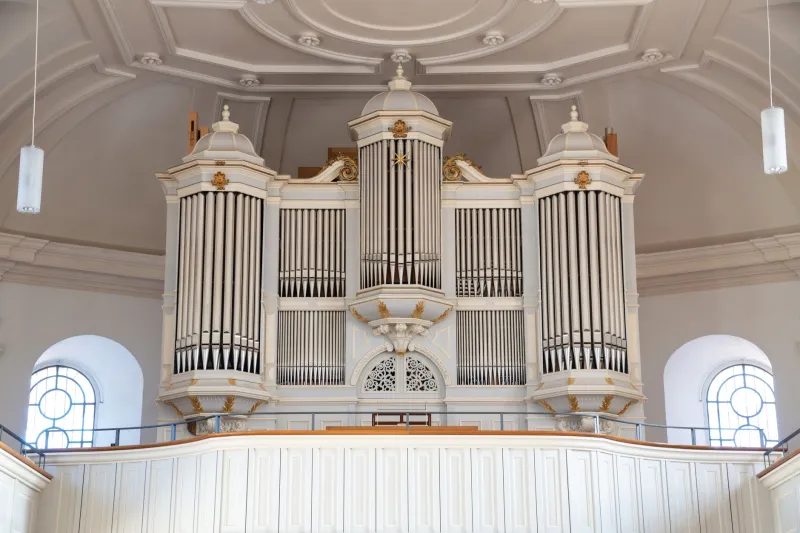
In the nave of a limestone church in rural Ohio, a man named Gerald Hecht is lying on his back inside a wooden cabinet roughly the size of a wardrobe closet. He is holding a flashlight in one hand and a leather punch in the other. Above him, rows of tin and wood pipes — some no wider than a pencil, others as broad as a man's forearm — rise toward the vaulted ceiling in orderly silence. The organ has not spoken in fourteen months. Gerald intends to change that.
"Most people only hear the organ on Sundays," he says, his voice muffled by the enclosure. "But the organ is always present. It's part of the architecture. When it stops, the room loses something it can't replace."
Hecht is one of perhaps three hundred working pipe organ builders and restorers in the United States — a number that has declined steadily over the past four decades, even as the instruments they serve have aged into an ever more fragile condition. The American Institute of Organbuilders estimates that tens of thousands of pipe organs remain in active use across the country, housed in churches, university chapels, concert halls, and civic auditoriums. Many of these instruments are more than a century old. A significant portion have not received meaningful maintenance in a generation.
A Craft Measured in Centuries
The pipe organ is among the oldest complex machines in continuous use by Western civilization. Instruments of recognizable form were documented in medieval European cathedrals, and the fundamental principles of their construction — pressurized wind, mechanical action, resonant pipe — have changed less than one might expect over the intervening centuries. What has changed is the degree to which modern society understands, values, or maintains them.
Building a pipe organ from scratch requires command of woodworking, metalworking, pneumatics, acoustics, electrical systems, and voicing — the delicate art of shaping each pipe's tone through minute physical adjustments. No single trade school in America offers a comprehensive degree in organbuilding. The knowledge is transmitted almost entirely through apprenticeship, a system that mirrors the guild traditions of medieval Europe more than it does contemporary vocational training.
Martha Elspeth Crane, who operates a restoration workshop in central Pennsylvania, learned her trade under a German master who had himself trained in the Rhine Valley. She spent four years as an apprentice before touching a pipe organ in a professional capacity. "You learn to listen before you learn to act," she explains. "Every instrument has its own voice, its own history. The worst thing you can do is approach a restoration with a predetermined idea of what the organ should sound like."
This philosophy — of listening before acting, of serving the instrument's original intention — is central to the ethic of serious organ conservation. It stands in deliberate contrast to the approach of simple replacement, which is the fate many aging instruments suffer when congregations or institutions lack the resources or inclination for proper stewardship.
The Economics of Extinction
The financial pressures bearing down on historic pipe organs are considerable. A full restoration of a large church instrument can cost anywhere from two hundred thousand to well over a million dollars, depending on the instrument's size, condition, and complexity. For many rural and urban congregations alike, particularly those whose membership has declined over recent decades, such expenditure is simply beyond reach.
The alternative — replacement with an electronic digital instrument — is increasingly common and increasingly controversial. Digital technology has advanced to the point where casual listeners may not immediately perceive the difference. But organbuilders and serious musicians are unequivocal: no electronic reproduction captures the physical presence of a pipe organ, the way its sound inhabits and reshapes the acoustics of a room, the harmonic complexity that emerges from metal and wood vibrating in real space.
"A digital organ plays notes," says Crane. "A pipe organ plays the room."
Beyond the sonic argument lies a preservation imperative. Many historic American pipe organs represent the work of builders whose reputations defined an era — firms like Skinner, Hook & Hastings, Casavant, and Möller, whose instruments are now recognized as significant cultural artifacts in their own right. The loss of even a single example from a notable builder represents an irreversible diminishment of the national heritage.
Some state historic preservation offices have begun to recognize pipe organs as qualifying landmarks, making them eligible for preservation tax credits and grant funding. The Organ Historical Society, founded in 1956 and based in Richmond, Virginia, maintains a comprehensive census of significant American instruments and advocates actively for their protection. But institutional support remains inconsistent, and the burden of preservation falls disproportionately on private craftspeople and dedicated volunteers.
Voices of the Unheard
Beyond the grand instruments of celebrated concert halls lie hundreds of smaller organs in modest sanctuaries, college chapels, and community auditoriums — instruments that will never attract foundation grants or national media attention, but whose preservation matters profoundly to the communities they serve.
In a predominantly African American Baptist congregation in Memphis, Tennessee, an 1898 tracker organ — one of the oldest surviving instruments in the Mid-South — has been under restoration for three years, funded through a combination of community fundraising and a small grant from a regional arts council. The organbuilder overseeing the project, a soft-spoken man named DeShawn Abernathy who trained in Boston and returned south to open his own workshop, describes the work as something greater than technical repair.
"This organ has been part of this congregation's worship for a hundred and twenty-six years," he says. "It was there during Jim Crow. It was there during the civil rights movement. It's not just a musical instrument. It's a witness."
This sense of the pipe organ as a keeper of communal memory — as a participant in the life of a place rather than merely a furnishing within it — animates the work of the most committed conservators. They are not merely repairing mechanisms. They are tending to something that carries the accumulated resonance of generations.
Teaching the Next Generation
The succession crisis in American organbuilding is real, but not without hopeful counterpoint. A handful of dedicated programs — among them workshops offered through the Eastman School of Music, occasional intensives hosted by the American Institute of Organbuilders, and informal apprenticeships arranged through regional guilds — are drawing young people into the trade with notable enthusiasm.
Social media has played an unexpected role. Videos documenting pipe organ restorations have accumulated millions of views on platforms where one might least expect such arcane craftsmanship to find an audience. The instruments, it turns out, are genuinely fascinating to observe — their mechanical complexity, their scale, and the almost alchemical transformation of a silent cabinet into a singing presence in a room.
Gerald Hecht, back in his Ohio church, emerges from the cabinet with a smudge of pipe cement on his forearm and a quiet satisfaction on his face. He will spend two more days completing the restoration before the organ is ready for its first tuning. Then, if all goes well, it will speak again — filling the limestone nave with a sound that, he hopes, will outlast him by a century or more.
"I won't hear the end of this story," he says, gathering his tools. "None of us do. That's the whole point."