Cloth and Continuity: The Immigrant Textiles That Wove New Lives Into the American Story
Among the objects Marta Szymańska carried from Kraków to Chicago in 1923 was a linen tablecloth embroidered by her mother in the Małopolska tradition — intricate geometric borders in red and black thread, worked in a pattern that her family had used for at least three generations. The cloth survived two world wars, a Depression, and six decades in the drawer of a house on Milwaukee Avenue. When Marta died in 1987, her granddaughter almost gave it to a church rummage sale. She did not understand, yet, what she was holding.
That granddaughter, Patricia Wojcik, is now a textile conservator at a regional history museum in Illinois. The tablecloth hangs in her office, framed behind UV-protective glass. It is, she will tell you, the most important object she owns — not for its monetary value, which is modest, but for what it encodes: a woman's skill, a family's aesthetic identity, a community's way of marking the threshold between ordinary time and sacred occasion, carried intact across an ocean into an entirely different world.
"My grandmother couldn't always explain in words what she missed about home," Wojcik says. "But she could show you. She showed you with the cloth."
The Language of Thread
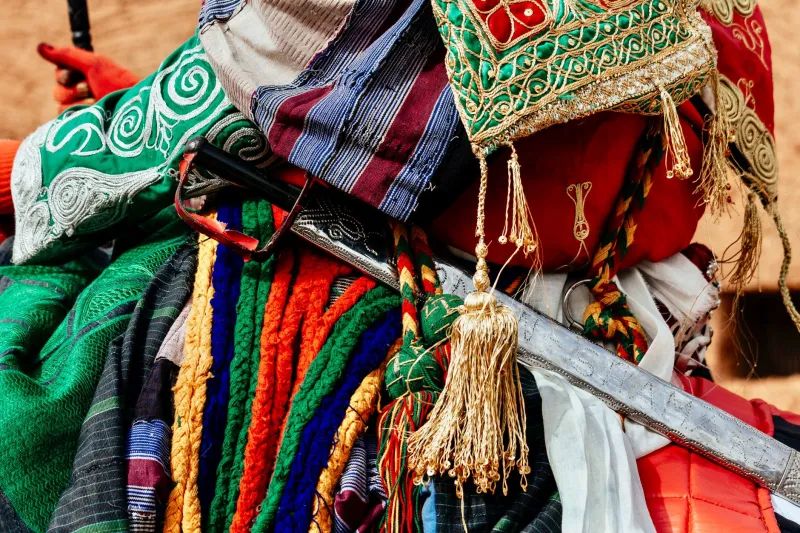
Textile traditions have served as vehicles of cultural transmission across virtually every immigrant community that has contributed to the formation of American society. The mechanisms differ — German Hausfrauen stitched samplers that taught daughters both the alphabet and the moral vocabulary of the household; Mexican women carried the rebozo, a versatile woven shawl whose regional patterns encoded geographic and social identity; Chinese immigrants brought embroidered silks whose symbolic vocabularies referenced cosmologies and kinship systems invisible to American eyes.
What unites these traditions is their function: to maintain, in material form, the continuity of a cultural self that migration placed under profound pressure. In a new country where language, architecture, food, and social custom were all foreign, the textile object offered a portable piece of the world one had left — something that could be touched, used, and passed on.
Dr. Yuki Tanaka, a material culture scholar at the University of Washington whose research focuses on Japanese American textile traditions, describes this function with precision. "The object holds memory in a way that spoken language cannot," she explains. "When a Nisei grandmother wrapped her grandchild in a cloth she had brought from Japan, she was doing something that words alone could not accomplish. She was making the continuity physical."
What the Museums Hold
Across America, museum collections contain extraordinary concentrations of immigrant textile heritage — much of it inadequately documented, some of it actively deteriorating, and a considerable portion still unidentified as to its cultural origin, age, or maker.
The Smithsonian's National Museum of American History holds one of the most significant collections of immigrant domestic textiles in the country, including Pennsylvania German fraktur-decorated linens, Scandinavian weavings brought to the upper Midwest by nineteenth-century settlers, and a remarkable group of Hawaiian quilts that fuse New England missionary quilting traditions with indigenous Hawaiian aesthetic sensibilities. The Ellis Island National Museum of Immigration maintains a textile archive that includes garments worn during the crossing — some of them embroidered with protective symbols by mothers who believed the stitching itself might keep their children safe.
Smaller regional institutions often hold collections of surprising depth. The Balzekas Museum of Lithuanian Culture in Chicago possesses an exceptional collection of Lithuanian sashes and woven textiles, many of them brought by immigrants fleeing the Soviet occupation of the mid-twentieth century. The Ukrainian Institute of Modern Art, also in Chicago, regularly exhibits embroidered ritual objects — rushnyky, pysanky-inspired needlework, and ceremonial cloths — that document the persistence of folk artistic traditions across generations of diaspora.
"Chicago is one of the great textile cities in the world, if you know where to look," says Wojcik. "Every neighborhood that was built by immigrants is a neighborhood that was also built by textile traditions. Most of them are invisible now, tucked away in attics and museum storage. But they're there."
The Urgency of Documentation
The scholars and curators working in this field speak with consistent urgency about a narrowing window. The generation of immigrants who carried these traditions firsthand — who learned the stitches from their mothers, who understood the symbolic grammar of the patterns, who could name the villages and the occasions that gave the objects their meaning — is passing. Their children and grandchildren often possess the objects without possessing the knowledge to interpret them.
This is the gap that a growing network of community documentation projects is working to close, before it widens beyond recovery.
The Textile Society of America has funded several oral history initiatives specifically aimed at recording the knowledge of elderly immigrant women whose textile skills represent the last living link to Old World traditions. In Minnesota, a project working with Hmong American communities has documented more than four hundred examples of story cloths — a textile form developed by Hmong refugees to record the history of their displacement from Laos — alongside video interviews with the women who made them, many of whom are now in their eighties.
In Texas, a university-based project is cataloguing the embroidered blouses, or huipiles, brought by Maya and Mixtec immigrants from southern Mexico and Guatemala — garments whose woven patterns encode village identity, family lineage, and ceremonial status in ways that even many younger members of those communities can no longer fully read.
"We are in a race," says Dr. Tanaka plainly. "Not a race against time in the abstract — a race against specific people dying before we have recorded what they know. Every year we lose something that cannot be reconstructed from the object alone."
Living Traditions
The story is not only one of loss. Across America, immigrant and diaspora communities are actively sustaining and reinventing their textile traditions in ways that speak to both continuity and adaptation.
In Queens, New York — one of the most ethnically diverse urban environments on earth — embroidery circles, weaving groups, and textile workshops operate within Bangladeshi, Ecuadorian, West African, and Korean communities simultaneously, each maintaining distinct traditions while occasionally and productively influencing one another. In San Francisco's Chinatown, a nonprofit teaching traditional Chinese silk embroidery to second- and third-generation Chinese Americans has found its enrollment doubling in recent years, driven by young people seeking connection to a heritage they fear is slipping from their grasp.
Patricia Wojcik, back in her office in Illinois, runs her hand along the frame that holds her grandmother's tablecloth. She is teaching herself the Małopolska embroidery tradition, working from archival photographs and the guidance of a scholar in Kraków whom she has never met in person but corresponds with regularly.
"My grandmother brought this cloth to America to remember who she was," Wojcik says quietly. "I'm learning to make one so my daughter will know who she is. That's what these traditions are for. That's always what they were for."