Painted on Pavement, Written in Rain: The Sidewalk Artists Reclaiming America's Streets as Sacred Canvas
The Canvas Beneath Our Feet
There is something quietly radical about an artist who kneels on concrete for three days straight, laboring over a work of extraordinary beauty that will vanish with the next rainfall. No gallery wall will hold it. No collector will acquire it. The only archive is memory — and perhaps a photograph, if a passerby thought to stop long enough.
This is the world of the American sidewalk painter, and it is a world very much alive.
Across the United States, from the modest courthouse squares of small Midwestern towns to the broad plazas of coastal cities, chalk artists and community organizers are reclaiming the ancient European tradition known as madonnari — a practice born on the streets of sixteenth-century Italy, where itinerant painters rendered sacred images in pigment on public stone to earn the charity of passersby. That tradition has traveled far from its origins. In contemporary America, it has been remade into something distinctly its own: civic, celebratory, and surprisingly profound.
A Tradition Carried Across an Ocean
The word madonnari derives from the Italian for Madonna, the religious subjects those earliest street painters most commonly depicted. For centuries, the practice remained a largely European phenomenon, associated with festival days, cathedral forecourts, and the wandering artisan's need to survive. It was not until the latter decades of the twentieth century that the tradition found serious footing in the United States.
The catalyst, by most accounts, was the I Madonnari Italian Street Painting Festival, launched in 1987 on the grounds of the Old Mission Santa Barbara in California. Conceived as a cultural exchange and community celebration, the event introduced American audiences to the scale, technical ambition, and ceremonial spirit of the form. Artists arrived with chalk and chalk pastels, squared off sections of pavement, and proceeded to fill them with reproductions of Renaissance masterworks, original compositions, and portraits of local significance.
What organizers discovered was that American crowds responded not merely with admiration, but with something closer to reverence. People lingered. They returned the next day to watch the work progress. They brought their children. They stayed to watch the rain.
The Santa Barbara festival has continued annually ever since, and it seeded a movement. Today, street painting festivals operate in dozens of states, ranging from intimate neighborhood gatherings to multi-day civic spectacles drawing tens of thousands of visitors. Each has developed its own character, its own relationship to local history, and its own understanding of why impermanence, rather than diminishing the work, elevates it.
The Art of Working on Your Knees
Ask any experienced street painter about the physical reality of the craft and the answer arrives with a mixture of wry humor and genuine devotion. The work is demanding in ways that studio painting simply is not.
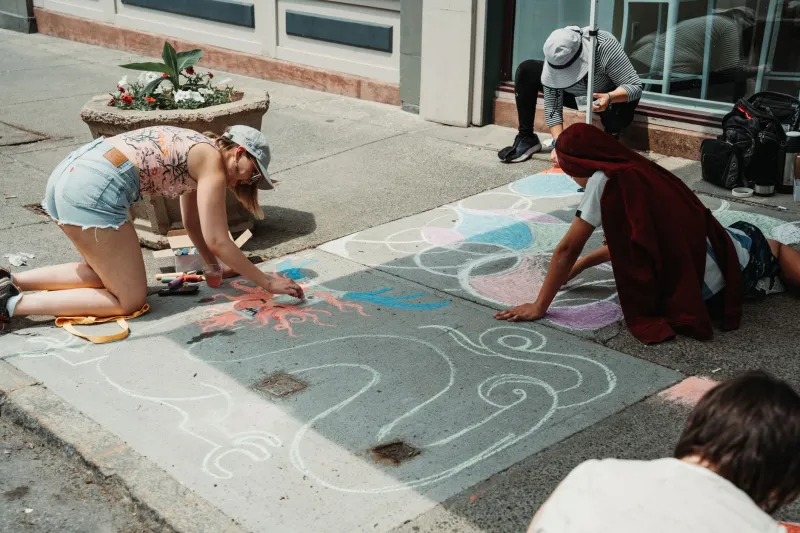
Artists typically begin by gridding their assigned pavement section, scaling up a prepared design square by careful square. They work in chalk and chalk pastels — materials that behave differently on rough concrete than on paper or canvas, requiring constant adjustment of pressure, layering technique, and color mixing. They work in direct sun, in summer heat, often without the benefit of shade. Their knees ache. Their backs protest. Fine chalk dust settles into everything.
And still they come back the next morning.
For many practitioners, the discipline required by the medium is inseparable from its appeal. The pavement is unforgiving. Errors cannot be concealed the way they might be in oil paint. The scale — works commonly span twelve, twenty, even forty square feet — demands both technical precision and the willingness to make bold, committed marks. There is no hedging on pavement.
Some of the most accomplished American street painters have spent years developing what amounts to an entirely distinct visual language, one calibrated to the specific demands of horizontal viewing, outdoor light, and rough texture. The foreshortening required to make a flat image read correctly when viewed from a standing position involves the same optical mathematics that Renaissance painters applied to ceiling frescoes. In this sense, the madonnari tradition connects its practitioners to a lineage of considerable antiquity.
Democracy and the Public Square
What separates street painting from nearly every other visual art form practiced in America today is its fundamental publicness. There is no admission fee. There is no velvet rope. A child eating a funnel cake at a festival can stand as close to the work as any curator or collector, and the painting will not distinguish between them.
This democratic quality is not incidental. It is, for many artists and organizers, the entire point.
In an era when access to the fine arts remains unevenly distributed across lines of class, geography, and education, the street painting festival offers something genuinely rare: world-class artistic ambition delivered directly to the public square, literally at the public's feet. Communities that may lack a major art museum or a robust gallery scene can, for a weekend each summer, experience the creation of work that would not look out of place in a grand European institution — and then watch it dissolve.
That dissolution carries its own instruction. In a culture that prizes permanence, accumulation, and the archiving of everything, the street painting reminds its audience that some of the most meaningful experiences are precisely those that cannot be kept. The work asks viewers to be present. It rewards attention. It teaches, gently but insistently, that beauty does not require a permanent address.
Local Memory, Rendered in Chalk
As the American street painting tradition has matured, many artists and festivals have turned deliberately toward local subject matter, using the medium to honor community history in ways that feel both monumental and intimate.
Artists have rendered portraits of founding citizens on the very pavement outside the buildings those citizens constructed. They have depicted vanished landmarks — theaters, train depots, family farms — that live now only in photographs and recollection. They have commemorated civil rights milestones, agricultural heritage, and the faces of ordinary people whose contributions to a community's life were never recorded in bronze or marble.
There is something particularly fitting about using a temporary medium to honor histories that were themselves considered temporary at the time — the lives of working people, the rhythms of neighborhoods that have since been transformed beyond recognition. The chalk image and the human memory it depicts share the same vulnerability. Both require active tending to persist.
Gathering as the Work Itself
Perhaps the most underappreciated dimension of the street painting tradition is what it does not depict: the gathering it produces simply by existing.
Festival organizers across the country speak of the same phenomenon. Strangers stop beside one another to watch an artist blend color into a shadow. Conversations begin between people who would not otherwise have spoken. Children ask questions. Older residents share recollections prompted by a face or a scene rendered in chalk. For a few days each year, a section of pavement becomes the most alive place in a given town.
This is heritage work in the deepest sense — not the preservation of objects, but the cultivation of the conditions under which a community recognizes itself. The painting is the occasion. The gathering is the inheritance.
When the rain eventually comes and the image returns to nothing, what remains is not absence. It is the particular quality of attention that beauty demands and community sustains. In that sense, the sidewalk painters are not making temporary art at all. They are making something that lasts in the only way that truly matters: in the people who stood there, looked down, and remembered.