A Room Full of Reasons to Stay: The Independent Bookshops Anchoring America's Literary Communities
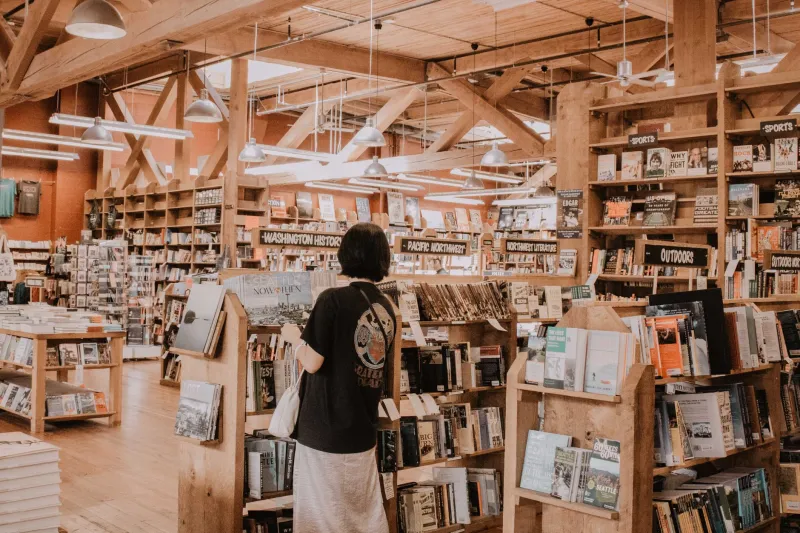
There is a particular quality of light inside an old independent bookstore — something to do with the way afternoon sun filters through a window display of paperbacks, warming their spines to amber. It is a light that feels unhurried. It suggests that whatever you came looking for, you have time to find it, and that the finding itself is the point.
This quality of unhurried attention is, perhaps, the most subversive thing an independent bookshop offers in contemporary America. In a commercial culture organized around speed, efficiency, and the elimination of friction, the independent bookstore insists on friction — on the productive resistance of browsing without certainty, of conversation without agenda, of discovery without an algorithm to guide it.
That insistence has proven, against considerable odds, to be a form of resilience.
The Survivors
The consolidation of American bookselling over the past three decades reads, in retrospect, like a cautionary tale that keeps refusing its own conclusion. The rise of the national chain bookstore in the 1980s and 1990s was widely predicted to extinguish independent shops. It did shutter thousands. Then came the internet retailer, and the predictions of total extinction grew louder. The Kindle arrived. The pandemic closed storefronts. And yet, according to the American Booksellers Association, the number of independent bookstores in the United States has actually grown over the past decade, from roughly 1,651 member stores in 2009 to more than 2,500 by the early 2020s.
The shops that survived, and those that opened in the years since, share a common understanding: they are not primarily in the business of selling objects. They are in the business of creating a place.
"If I just wanted to sell books, I'd have a warehouse," says Constance Okafor, who has operated a shop in a narrow Victorian storefront in Savannah, Georgia for nineteen years. "What I have instead is a neighborhood. People come here because they want to be somewhere that feels like it was made by a person who cares. And it was."
Okafor's shop — its shelves hand-lettered, its staff recommendations written on index cards in individual handwriting — is a portrait of intentional curation. She carries titles that no algorithm would surface for a general audience, alongside the expected bestsellers. She hosts a monthly reading group for elderly patrons who have few other regular social engagements. She keeps a section she calls "Savannah Voices," dedicated entirely to writers with a documented connection to the region, including self-published local authors who would find no space on the shelves of a chain.
The Archive Function
This last detail points to something that distinguishes the independent bookstore from its corporate counterparts in ways that extend well beyond atmosphere. The independent shop, by virtue of its rootedness in a specific community, functions as a kind of living archive of local literary culture.
In communities across America, independent bookstores have become the primary institutional memory of regional writing — maintaining backlist titles, hosting author events that national chains would not schedule, and preserving the relationships between writers and their home places that larger commercial operations have no incentive to sustain.
In Taos, New Mexico, a bookshop established in the 1970s maintains what its current owner describes as the most complete collection of New Mexico literature available for purchase anywhere in the state. In Louisville, Kentucky, a shop specializing in Southern writing has hosted more than a thousand author readings over its thirty-year history, many of them recorded and archived as an informal oral history of the region's literary life. In Portland, Oregon, the legendary Powell's Books — now in its fifth decade — has become so thoroughly identified with the city's cultural identity that it functions, in the minds of many residents, as a civic institution rather than a commercial enterprise.
"There are cities where the bookstore is part of what the city thinks it is," says David Lerner, a bookseller in Ann Arbor, Michigan, who has studied the sociology of independent retail. "When those stores close, something happens to the city's sense of itself. It's not melodrama — it's a real and measurable loss of cultural infrastructure."
The Human Shelf
What no algorithm replicates, and what independent booksellers speak of with unmistakable pride, is the relationship between a knowledgeable human bookseller and a reader in genuine search of something. This relationship — part recommendation, part conversation, part intuition — is the invisible inventory of the independent shop.
The best booksellers carry in their heads a vast map of their customers' reading histories, their enthusiasms and aversions, the books that moved them and the ones that fell flat. They make connections across genres and decades that no data set can replicate, because the connections are not based on purchasing patterns but on something harder to quantify: an understanding of what a particular person, at a particular moment in their life, might need to read.
"I had a customer come in last spring," recalls Okafor, "and she said she'd just lost her mother and didn't know what she wanted. I didn't give her a grief memoir. I gave her a novel about a woman who learns to sail in her sixties. She came back two weeks later and said it was exactly right. No algorithm would have found that."
These transactions — small, private, and entirely resistant to quantification — are what independent bookstores are actually selling. The book is the medium; the experience of being known, of being seen by someone who genuinely cares about reading, is the product.
Gathering Places for the Unhurried
Beyond the individual transaction, independent bookstores have evolved into gathering places of a kind increasingly rare in American civic life — spaces that are neither commercial nor governmental, neither religious nor explicitly political, but which serve a deeply social function.
Author readings, literary festivals, children's story hours, writing groups, book clubs, poetry slams, local history discussions — the programming calendars of thriving independent bookstores read like the schedules of small community centers. And in many cases, particularly in towns that have lost other gathering infrastructure, that is precisely what they have become.
In a small city in western Massachusetts, a bookshop that opened during the pandemic has become, in the words of its owner, "the living room the town didn't know it needed." Its events draw people who had no previous relationship with books but who found, in the shop's warm and unhurried atmosphere, a kind of belonging they had been searching for without knowing it.
This is, ultimately, what the survivors of America's independent bookselling culture have understood about their own resilience: that they are not competing with online retailers on the grounds of price or convenience, because on those grounds they cannot win. They are competing on entirely different terrain — the terrain of presence, of community, of the irreplaceable experience of being in a room full of books with other people who love them.
That terrain, it turns out, is larger than anyone predicted.