Geography of the Imagined: The Fiber Artists Stitching America's Forgotten Landscapes Into Being
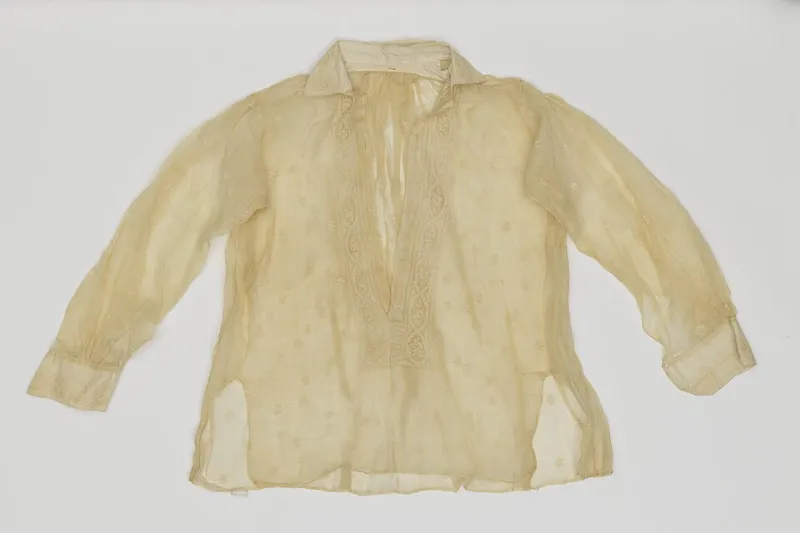
Photo: Unknown artistUnknown artist, Public domain, via Wikimedia Commons
There is a tapestry hanging in a gallery in Taos, New Mexico, that depicts a landscape no cartographer has ever charted. Its mountains are embroidered in wool the color of late afternoon shadow. Its rivers run in silk thread, branching and doubling back in ways that defy hydraulic logic. Along its margins, in lettering so fine it requires a magnifying glass to read, are the names of places that exist only in the oral tradition of a Pueblo community whose relationship to that terrain stretches back centuries before any European surveyor arrived with his instruments.
The artist, Renata Morningstar Chávez, spent four years making it.
"Maps tell you where power decided things were," she says. "This tells you where people actually lived."
Chávez is one of a growing number of contemporary textile artists across the United States who have turned to fiber—embroidery, weaving, appliqué, tapestry, quilted assemblage—as a medium for documenting what conventional history has left uncharted. Their work ranges from the grandly scaled to the intimately domestic, but it shares a common impulse: the belief that needle and thread can do something that ink and paper cannot. It can hold memory in the body of a material, in the labor of making, in the accumulated hours of a hand moving across cloth.
Thread as Testimony
The decision to work in fiber is rarely accidental among this generation of artists. Many speak of a deliberate rejection of media that feel ephemeral or alienating—the screen, the photographic print, the digital rendering—in favor of something that requires presence and patience. There is, in the act of embroidering a map, an insistence on slowness that functions as a kind of argument.
"When I stitch a place, I have to think about it for every hour I'm working on it," explains Delphine Okafor, a fiber artist based in New Orleans whose large-format embroideries document the geography of neighborhoods swallowed by Hurricane Katrina and subsequent development. "You can't rush through it. The time you spend with it becomes part of what the piece is."
Okafor's work draws on oral histories collected from former residents of the Lower Ninth Ward, translating their spoken recollections of specific blocks, specific houses, specific trees into a stitched topography. The resulting pieces are simultaneously maps and elegies—precise enough to be geographically legible, and suffused with a grief that no satellite image could convey.
For artists working with indigenous histories, the choice of fiber carries additional layers of significance. Across many Native American traditions, textile-making has long been a form of cultural transmission—a way of encoding knowledge, genealogy, and spiritual practice into material that could survive displacement and suppression. Contemporary artists working in these traditions are not simply reviving a craft; they are continuing a conversation that colonialism interrupted.
The Folklore of Place
Regional folklore presents particular challenges and opportunities for the fiber artist. Unlike historical documents, folklore exists in variation—the same story told differently in different mouths, the same landscape named differently by different communities. Translating this multiplicity into a single textile requires choices, and those choices are themselves a form of interpretation.
In eastern Tennessee, artist and educator Wren Hollis has spent the past six years creating a series of stitched maps she calls the "Appalachian Concordance"—large-scale works that layer the documented geography of specific mountain counties with the folkloric landscape of the same territory: the locations of haunted hollows, the paths of legendary floods, the sites of community gatherings that no longer occur but are still remembered in song.
"The official map and the folk map of a place are almost never the same," says Hollis. "The official map tells you where the road goes. The folk map tells you why nobody takes that road after dark. Both are true. Both are history."
Her process involves extensive fieldwork—interviews with elderly residents, visits to local historical societies, consultations with folklorists and ethnobotanists—before a single stitch is placed. The resulting works are dense with information, requiring viewers to spend time with them in the way one might spend time with a primary source document. They are beautiful, but they are also rigorous.
Young Artists, Ancient Techniques
Perhaps the most striking aspect of this movement is its demographic character. The artists driving it are, in many cases, remarkably young—in their twenties and thirties, trained in contemporary fine art programs, and fully conversant with the digital tools they have chosen not to use for this particular purpose.
For many of them, the turn toward fiber was catalyzed by a sense of cultural urgency. Growing up in communities whose histories were either misrepresented or entirely absent from mainstream cultural narratives, they found in textile-making a means of self-documentation that felt both ancient and immediate.
"I learned to embroider from my grandmother," says Chávez. "She learned from hers. When I use those same stitches to make a map of a landscape my grandmother described to me, I'm not doing something new. I'm doing something that has always been done. I'm just making it visible."
The institutional art world has taken notice. Museums and galleries that once regarded fiber art as a minor or decorative category have begun to reckon with its capacity for intellectual and political seriousness. Major exhibitions at institutions including the Smithsonian American Art Museum and regional art centers across the South and Southwest have brought this work to audiences who might not have encountered it otherwise.
The Archive That Breathes
What distinguishes the stitched map from the drawn map, the woven tapestry from the printed poster, is something that is difficult to name precisely but immediately apparent to anyone who has stood before one of these works. There is a quality of presence in them—a sense that the labor of their making has left something in the material itself, some residue of attention and intention that the viewer can feel.
This quality is not incidental. It is, for many of these artists, the entire point. In a cultural moment characterized by the rapid production and equally rapid obsolescence of images, the textile archive offers a different proposition: that some things are worth making slowly, that the act of making is itself a form of remembering, and that the landscapes and stories encoded in thread will outlast the hands that placed them there.
"Paper burns," says Okafor. "Cloth endures. My grandmother's quilts are still in my family. The photographs from that same period are gone. I think about that every time I thread a needle."
The geography of the imagined, it turns out, may be the most durable geography of all.